OPINION: Examine the Medical Competency of Crash-Involved Drivers


Council Member Brad Lander recently proposed removing the responsibility for investigating serious automobile crashes from the NYPD, and placing it instead at the Department of Transportation. As a Certified Driver Rehabilitation Specialist who has worked with many individuals involved in crashes, I support that idea — and would like to suggest another element that’s crucial for street safety: the Collision Investigation Squad should also investigate the medical competency of drivers involved in crashes.

Medical competency of drivers is only considered if the Department of Motor Vehicles Medical Review unit receives a report — but such referrals are not mandated and, if they occur, it may be months later. In other words, drivers involved in so-called killed or seriously injured incidents rarely face medical scrutiny, and continue driving, unless the DMV eventually intervenes.
Timely medical screening and follow-up referral to the DMV is essential. According to the DMV, its “Medical Review Unit will be notified if a police accident [sic] report indicates a motor vehicle accident [sic] may have been caused by” any of these conditions:
- loss of consciousness
- falling asleep
- fatigue or drowsiness
- illness
- prescription medication
- physical or mental disability
But police officers generally do not have the skills to identify a driver’s medical impairment, and so they do not make such reports consistently. That’s why it’s so crucial that a reformulated CIS — under the auspices of the DOT — have on its staff a medically qualified screener fully familiar with medical guidelines developed by the DMV and consensus statements, such as the Clinicians Guide to Assessing and Counseling Older Drivers.
The problem is pressing: Medical impairments have figured in a number of recent high-profile fatal crashes in New York City. Last year, 59-year-old Alexander Katchaloff ran over and killed 10-year-old Enzo Farachio in Brooklyn during a “medical episode.” Two years ago, motorist Dorothy Bruns killed two children in Park Slope. Bruns had a seizure disorder and was told by her doctor not to drive. In yet another example, 17-year-old Maddie Sershen was struck and killed in Whitestone in 2018 by an 88-year-old female driver who had glaucoma. The driver knew she had the eye disease, which constricts the field of vision.
Other common conditions, notably stroke, can cause visual field loss through damage to the visual pathways in the brain. Sometimes strokes are “occult” — never diagnosed.
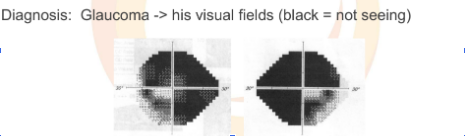
In my professional experience, the extent of visual-field loss, whether caused by glaucoma, diabetic retinopathy, or brain injury, is rarely appreciated by the individual with the condition. Many motorists may be un- or under-aware that they suffer from conditions like visual field loss which could prevent them from noticing pedestrians like Maddie Sershen. (See, for example, the scan below, which shows the glaucomatous visual-field loss of a 39-year-old individual who did not know he was affected by the condition.) Medical screening and evaluation are necessary because there are problems of which individuals are not (and cannot be) aware.
As things stand, a driver involved in a fatal crash can expect that the DMV will conduct a fatal crash hearing about six months to a year following the incident. Such hearings address culpability and determine whether the driver’s license will be revoked or suspended. The fatal crash hearing does not explicitly address medical competency. In the case of medically compromised drivers, culpability will depend on whether the driver could have been aware of a problem, was non-compliant with treatment, or had been advised not to drive.
Immediately following a serious crash, the city’s CIS could make a referral to the Department of Motor Vehicles Medical Review Unit, which has procedures for driver re-evaluation, and may receive reports from the police, physicians, family members and other concerned individuals. In serious crashes, such procedures should be expedited — addressing drivers’ medical competency immediately in the interest of public safety.
The driver should not be allowed to resume driving until medically cleared. Vehicles are checked out before being returned to service. Why not drivers?
Besides allowing us to protect the public from medically impaired drivers, such investigations would give us a better understanding of medical conditions that could contribute to traffic violence — information that could guide standards for driver licensing.
Rosamond Gianutsos, a psychologist, is a Certified Driver Rehabilitation Specialist and a fellow of the American Academy of Optometry. Follow her on Twitter @driverehab.

Streetsblog has migrated to a new comment system. New commenters can register directly in the comments section of any article. Returning commenters: your previous comments and display name have been preserved, but you'll need to reclaim your account by clicking "Forgot your password?" on the sign-in form, entering your email, and following the verification link to set a new password — this is required because passwords could not be carried over during the migration. For questions, contact tips@streetsblog.org.