Build A Bike Lane, Get $1.87B in Economic Activity!
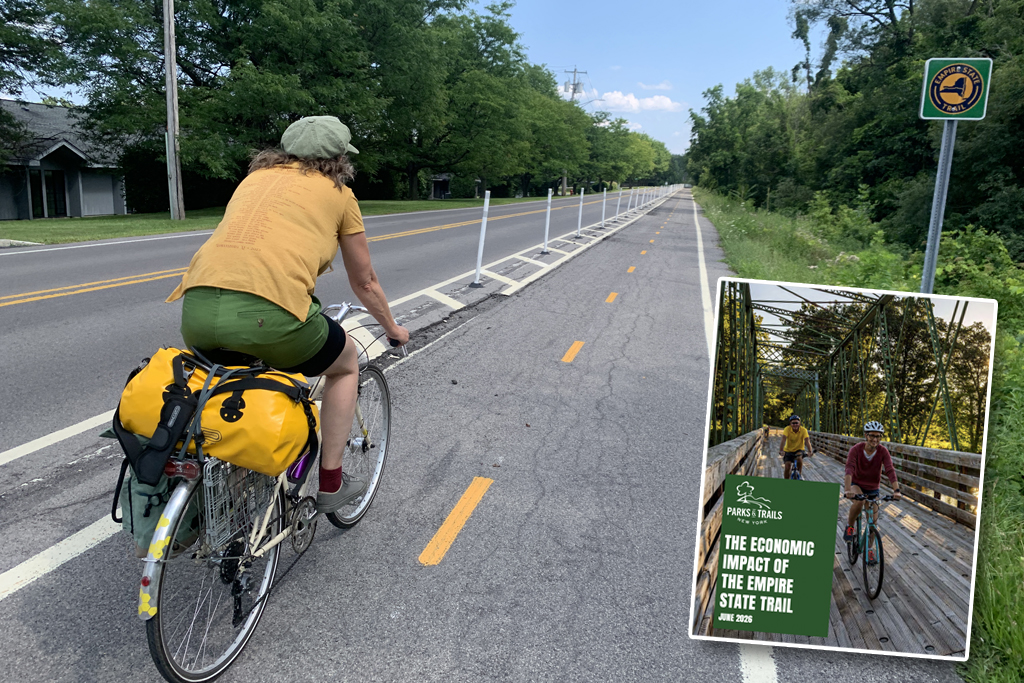
The Empire State Trail injects almost $2 billion into the New York State economy annually, according to a study released earlier this month.
The study, conducted by Parks & Trails New York, revealed that there are 9.75 million annual visits to the trail, from both residents and tourists, who not only walk and bike the multi-use trail but stop to eat, stay in hotels, purchase souvenirs or pay for other recreational activities along the route. On average, visitors spend $30 a day at different stops — overnight visitors spend even more, averaging $540 of spending per visit.
“Trails are economic drivers for communities, they’re one of the smartest ways to do economic development,” said Dylan Carey, a spokesperson for Parks & Trails New York. He said the Empire Trail is particularly profitable because it connects numerous small towns, cities and rural communities across the state.
The trail itself is the longest, single-state, multi-use trail in the nation. Completed in 2020, it forks across New York State, with one segment connecting Albany to Buffalo, another stretching from Rouses Point, on the Canadian border, to Albany, and the last connecting Albany to Battery Park City, at the southern tip of Manhattan. It connects upstate New York’s cities such as Utica and Syracuse to smaller towns, like Newark and Schuylerville, and the state’s biggest metropolis. Businesses and residents of these towns are reaping the benefits.
The segment between Albany and New York City is the most profitable, according to the study, bringing in just more than $1 billion annually. The segment that runs from Rouses Point to Albany is the least fruitful, with a majority of that segment designated as on-road trail, which requires users to travel along the shoulder of roadways. It’s an area where improvements would pay off.
“The on-road facilities get much less use,” said Carey. He added that those segments of the trail don’t see the same economic benefit because they’re not trafficked as often by families and tourists — who tend to spend more money — but rather by serious cyclists and long-distance travelers who aren’t deterred by the close contact to cars driving at high speeds.
Sections of the trail where visitors travel on dedicated biking and walking paths or in protected bike lanes produced four times the economic activity of those on-road sections, the study showed. Carey said that he hopes that this revelation will convince state policy and decision-makers of the importance of expanding those off-road, protected sections of the trail.
Still, both on-road and off-road segments of the trail have been good for nearby businesses’ bottom lines. Every $1 of investment into the trail infrastructure returns $5.30 in sales revenue, according to the study. The businesses surveyed for the study reported that trail-related visitors accounted for 26.2 percent of annual sales.
Economic activity has been so good for businesses that 5 percent of the those surveyed by the study are actively considering relocating or expanding their business to be closer to the network of trails. Another 24 percent said that being close to the trail was a divisive factor in deciding on their current location.
Expanded economic impact has been particularly impactful in certain areas along the trail. Around two-thirds of the trail, or 540 miles, is located in communities identified by Empire State Development as moderately or severely distressed, facing higher rates of poverty and unemployment. The study revealed that the trail supports 9,690 jobs annually, with employees earning almost $650 million each year.
“Many of the small, rural communities that the trail is passing through are trying to reinvent themselves as tourism hubs,” said Carey. He said that the trail supports the local economic bases, ultimately improving the quality of life for residents.
The Empire State trail is not alone in providing cash for communities along its path. In Pennsylvania and Maryland, the shorter 130-mile Great Allegheny Passage generated $121 million in economic activity in 2019, according to an economic impact study done on the trail by the firm Fourth Economy.
Trails like both the Great Allegheny Passage and the Empire Trail provide crucial access to the outdoors. Almost 40 percent of Empire Trail users reported that they depend on the trail for at least half of their weekly physical activity and 70 percent of the visitors engage with more than an hour of physical activity each visit.
Users of the trail are also saving money on health costs through using the trail. According to the study, the trail generates more than $78 million in annual physical health benefits.
It also means that New Yorkers are spending less time in vehicles, and instead using the trail for their means of transportation. The trail is reducing vehicle travel by more than 96 million miles each year. The study reported that 68 percent of the users surveyed said that they drive less because of the trail.
Carey said he hopes this study will show officials how beneficial trails like the Empire State Trail can be for local economies, and will result in state investment in further improving the trail and expanding it into other parts of the state.

Read More:
Streetsblog has migrated to a new comment system. New commenters can register directly in the comments section of any article. Returning commenters: your previous comments and display name have been preserved, but you'll need to reclaim your account by clicking "Forgot your password?" on the sign-in form, entering your email, and following the verification link to set a new password — this is required because passwords could not be carried over during the migration. For questions, contact tips@streetsblog.org.