Environmental Groups Join to Fight Adams’s BQE Reconstruction
The city must scrap plans to shore up the deteriorating Brooklyn-Queens Expressway for another century, and instead work with the state to transform the entire highway corridor, environmental justice advocates demanded on Wednesday.
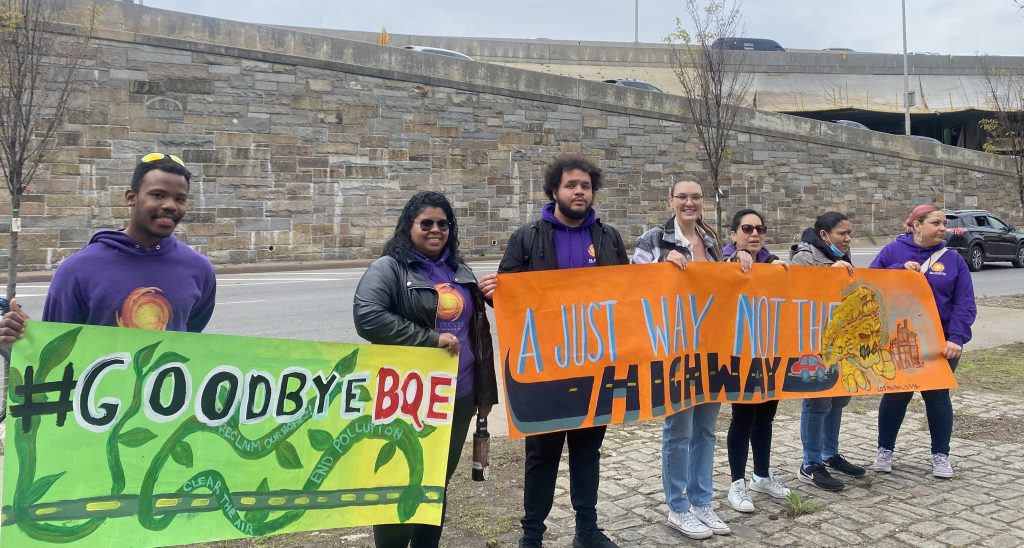
The new alliance — the Brooklyn-Queens Expressway Environmental Justice Coalition — rallied next to the roaring roadway at Third Avenue and 16th Street in Brooklyn with the slogan “A Just Way, Not the Highway,” slamming plans by city and state leaders to double down on the Robert Moses-era highway.
“Mayor Adams and Gov. Hochul need to fund our ideas and not ideas that widen highways and allow for more cars,” said Kevin Garcia, a transportation planner at the New York City Environmental Justice Alliance. “For decades, communities along the BQE have endured traffic congestion, air pollution, and unsafe walking conditions.
“We must challenge the auto-centric planning of previous and current planners,” Garcia added.
The city and state should rethink the entire BQE, which runs between the Verrazzano Bridge and Astoria, rather than the current piecemeal approach focusing largely on rebuilding the 1.5-mile triple cantilever section around Brooklyn Heights, along with some possible street-level tweaks at other sections.
The city’s Department of Transportation recently claimed it needed to rebuild the BQE’s crumbling cantilever for $5.5 billion to last for another 100 years lest the 130,000 daily vehicles that use the expressway — including 13,000 trucks — descend on local streets and harm communities that have suffered from pollution, traffic violence, and divided neighborhoods thanks to the highway for decades.
In other words, a smoke-belching highway near local roads to keep smoke-belching trucks off local roads.
Without the project, the agency says it also will have to close the degrading stretch by 2036 due to wear and tear, especially of overweight tractor trailers.
The federal government rejected a grant application by the city for $800 million for that project, and DOT’s line of reasoning for reinforcing the automobile behemoth was shot down by the very neighborhood groups officials argued it was working to save from carmageddon.
“We know that the current planning process for the BQE has been a sham,” said Sebastian David Baez of the Sunset Park-based group UPROSE. “If the city and state administration had it their way, working class communities of color like Sunset Park would continue to be sacrifice zones for another 100 years.”
The city and state did get a $5.6-million Reconnecting Communities grant from Washington, D.C. That money will go toward planning at least two proposals to improve the streets around the BQE north and south of the cantilever.
The groups called on officials to let the community lead the process, and revive long-standing proposals like covering over the trench in Williamsburg, also known as BQGreen, or making it easier to cross the deadly Hamilton Avenue beneath the elevated section of the highway next to Red Hook.
“We have less than one minute to pass by two streets and then a middle under the bridge,” said Quincy Phillips of the Red Hook Initiative. “I find it insane, I don’t think it’s safe at all.”
However, the Adams administration has been eyeing widening the decaying city-owned cantilever between Atlantic Avenue and Sands Street back to three lanes in each direction, up from the current two since former Mayor Bill de Blasio narrowed the road in 2021 to lessen the load — and even wider than the original three lanes, because they would have to meet current federal standards.
DOT is still conducting a traffic analysis comparing three versus two lanes on the cantilever, ahead of a larger environmental review of the cantilever rebuild this spring.
Brooklyn Heights Councilman Lincoln Restler said that six large lanes would add six million car and truck trips a year, and called the proposal “unconscionable.”
A mayoral BQE expert panel study found that a three-lane BQE at modern widths would increase vehicle capacity from a current 4,000 an hour to 6,000.
“It is governmental malpractice when Eric Adams and his team are pursuing to expand car and truck traffic in our communities, we will not stand for it,” Restler said at the rally.
The state owns 88 percent of the BQE in Brooklyn, but Albany transportation officials have said they have no plans to redo their portions of the highway.
Sections of the BQE going through Queens should also be part of the plans, said an environmental advocate from the World’s Borough.
“Spending billions of taxpayer dollars to expand the BQE will inflict more harm and dig us further into car-centric modes of transportation,” said Elaine O’Brien, co-founder of the Queens Climate Project. “This is an affront to the enduring harm of the BQE and the communities in Queens. We need to be included in this conversation.”
Spokespeople for city and state DOTs contended that the agencies are working with residents to address the ills of the highway, but a rep for the city said the agency has a “direct responsibility to meet the immediate needs” of the cantilever.
“Robert Moses-era urban highways like the BQE have divided communities and DOT is leading a community-driven effort to reconnect neighborhoods while making much-needed repairs to the city-owned portion of the BQE,” DOT rep Vin Barone said in a statement. “While the state owns 88 percent of the BQE, we support a comprehensive reimagining of the highway that reconnects communities and addresses its negative effects.”
State DOT spokesman Glenn Blain also sent over a statement.
“The state DOT has been working collaboratively with the city Department of Transportation, the community, and all our government partners to help develop a vision for the Brooklyn Queens Expressway that will look at alternative concepts to help reconnect communities along the highway,” he said.

Read More:
Streetsblog has migrated to a new comment system. New commenters can register directly in the comments section of any article. Returning commenters: your previous comments and display name have been preserved, but you'll need to reclaim your account by clicking "Forgot your password?" on the sign-in form, entering your email, and following the verification link to set a new password — this is required because passwords could not be carried over during the migration. For questions, contact tips@streetsblog.org.