Here’s the Risk to Straphangers of Kicking the Can on the MTA Capital Plan

Rumors are swirling that the long-awaited answer to the key question vexing the MTA — how the state’s $8.3 billion share of the unfunded portion of the MTA capital plan will be paid for — is that dreaded four-letter word: D-E-B-T.
According to the terms of a deal reached by Governor Andrew Cuomo and Mayor de Blasio in October, any additional debt should not be backed by MTA fares. But that deal could unravel — now, or in the future, when Cuomo is out of office.
What is the risk to straphangers if the deal implodes? I took a shot at calculating the answer, using my Balanced Transportation Analyzer model (Excel file).
The bottom line is that if the October agreement doesn’t hold up, financing the entire $8.3 billion “on the backs of transit users” would raise fares around 22-23 cents per ride. That would equate to an average 12 percent fare hike on top of the current average fare of $1.92. (That figure takes into account unlimiteds, free transfers, senior discounts, etc. and thus is well below the nominal $2.75 single-ride rate.)
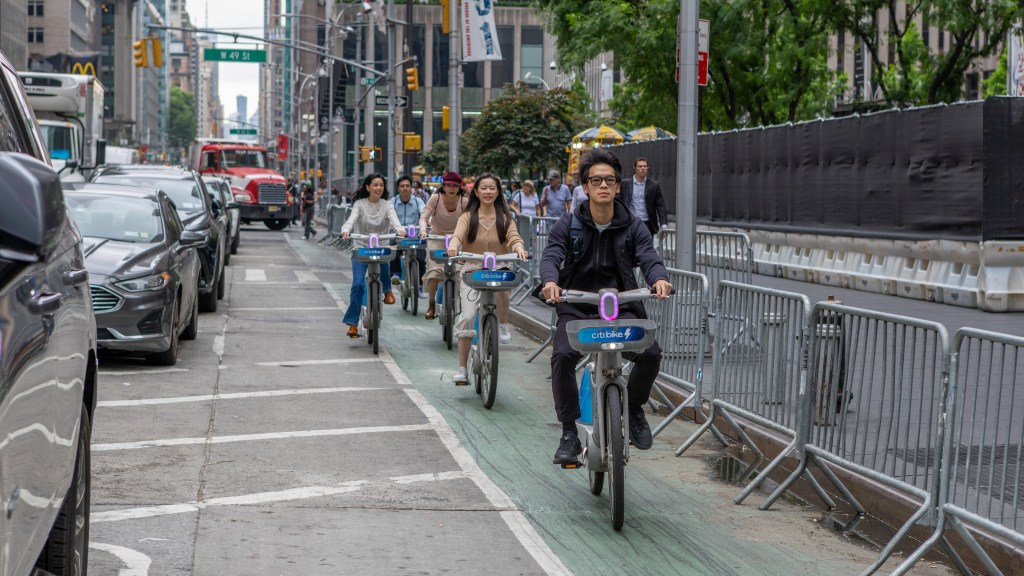
The current 30-day unlimited price of $116.50 would rise by $14.00, shooting to $130.50, with the annualized increase of $168 surpassing the $149 cost of a Citi Bike membership. And the increase would be on top of the 4 percent biennial fare hikes the MTA has programmed indefinitely to cover rising operations costs.
As harsh as that would be, it’s a mere half of the impact I estimated here last May, before the MTA trimmed both the scope and cost of its 2015-2019 capital plan and before Governor Cuomo offloaded $2.5 billion in financing obligations onto Mayor de Blasio, reducing the state’s unfunded commitment to $8.3 billion.
On the other hand, holding the hit to 12 percent assumes favorable financing, notwithstanding the Federal Reserve’s boost in interest rates last month as well as the potential strain on the state’s borrowing capacity from other infrastructure projects that the governor announced last week. Just a one point increase in the MTA’s borrowing rate, to 5 percent instead of the 4 percent I’ve assumed, would tack another three or four cents onto the required fare hike.
In addition to further impoverishing millions of low-income New Yorkers, a 12 percent increase in subway and bus fares would be projected to have these consequences, based on the BTA model:
- A 2 percent drop in subway and bus use;
- A 2 percent deterioration in travel speeds in Manhattan’s Central Business District as some of those dropped subway trips switch to cars;
- A nearly 1 percent decline in the number of people traveling to the CBD (27,000 fewer trips each day);
- Nearly half a billion dollars a year in costs from increased pollution, more traffic deaths and injuries, and more time lost sitting in traffic.
Here’s how I derived the 12 percent fare hike figure:
- First, I assumed that 85 percent of the debt service on the unfunded $8.3 billion would be paid through subway and bus fares (with the other 15 percent paid by LIRR and Metro-North passengers). That’s $7 billion.
- I assumed 30-year bonds with a coupon rate of 4%. From standard tables, the “fixed charge rate” to pay interest and principal is 5.78% per year, which computes to $408 million to service $7 billion in new debt.
- NYC Transit projected combined bus and subway farebox collections last year of $4.3 billion from 2.45 billion trips. Deleting free transfers leaves 2.24 billion paid trips, implying an average fare per paying ride of $1.92. To raise an additional $408 million in farebox revenues, each of the 2.24 billion paying trips must cough up an additional 18.2 cents per ride.
- That fare hike would trigger an estimated 2 percent drop in transit ridership, resulting in an annual revenue hit across the entire farebox of $75 million. To make back that lost revenue necessitates another increment to the fare, of around 4.4 cents per ride. The total fare hike required to meet the $408 million net revenue target is thus 18.2 + 4.4 cents, or an estimated 22.6 cents per ride. Weighed against the current per-ride fare of $1.92, the increase is 12 percent.

Charles Komanoff is a national expert on congestion pricing and traffic modeling, and is the former head of Transportation Alternatives. He is a longtime Streetsblog contributor. Reach him at komanoff@gmail.com.
Read More:
Streetsblog has migrated to a new comment system. New commenters can register directly in the comments section of any article. Returning commenters: your previous comments and display name have been preserved, but you'll need to reclaim your account by clicking "Forgot your password?" on the sign-in form, entering your email, and following the verification link to set a new password — this is required because passwords could not be carried over during the migration. For questions, contact tips@streetsblog.org.