In-Car Tech Would Force NYC’s Worst Drivers to Slow Down Under New Proposal

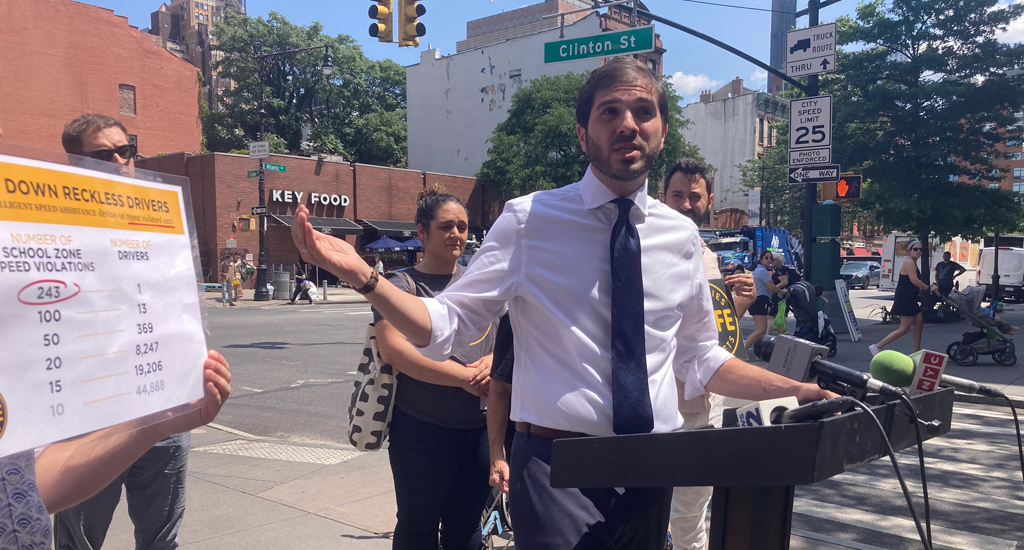
Dangerous drivers with at least six speeding tickets in a single year would be forced to install speed-limiting devices in their vehicles under new state legislation.
“We are going to literally force you to slow down by requiring you to install a speed limiter on your car,” bill sponsor state Sen. Andrew Gounardes warned reckless drivers on Tuesday during a press conference at the Atlantic Avenue intersection where a speeding driver killed Katherine Harris, 31, in April.
The proposal comes amid an historically deadly year for city streets, in which 132 people have died in crashes so far, including 49 pedestrians. Speed limiters have been shown to reduce traffic deaths by 37 percent, supporters said, citing a report from the European Transport Safety Council.
Joining the Brooklyn senate on Tuesday were street safety advocates, victims of traffic crashes as well as Brooklyn Democratic Council Members Lincoln Restler and Shahana Hanif. Assembly Member Emily Gallagher (D-Greenpoint), the bill’s other sponsor, did not attend due to jury duty, her office said.
“As more Americans continue to die from motor vehicle crashes than in any other country in the world, we need to take proactive and common sense measures to reduce traffic violence,” Gallagher said in a statement.
“Cars and trucks can act as weapons when used recklessly, and people who have repeatedly demonstrated they will endanger lives while operating vehicles should be limited in how fast they can drive.”
The proposed “speed governors” would be modeled after something called an ignition interlock device, which prevents individuals with previous drunk driving arrests from starting their car without proving their sobriety, the pols said.
Under Gounardes and Gallagher’s proposal, drivers with the tech installed in their vehicles could not travel more than 5 miles per hour over the speed limit. Data shows higher speed correlates with an increased likelihood of death.
The legislation would ultimately target the top three percent of drivers in the city, Gounardes said — specifically drivers with six or more speeding tickets over a year, or with 11 or more points on their license in an 18-month period.
The extra penalty is necessary to stop speedsters for whom a $50 camera ticket isn’t enough of a deterrent, Gounardes said.
“There is a persistent cohort of drivers who are getting five, six, seven, 10, 20, speeding tickets and drive on our streets recklessly without any consequences whatsoever, and just a slap on the wrist — $50 dollars every single time,” he said.
City officials have already implemented speed governors on their own workers. “Hard stops” by municipal drivers have dropped 36 percent in the year since Mayor Adams announced the installation of such devices on a tiny percentage of the city fleet, according to Gounardes.
“The city of New York has already done this for a municipal fleet and the results of that program have been astonishing,” the senator said.
“We know that the [technology] exits, we know that it works to slow down traffic, and now we are saying that we should apply this across the board to the worst of the worst drivers.”
Gounardes insisted his proposal would work better than the city’s Dangerous Vehicle Abatement Program, which let officials seize a car after its owner has gotten at least 15 camera-issued speeding tickets or five red-light tickets within 12 months, and then fails to show up for a city-mandated safe driving course. Only a handful of drivers have been impacted by the program so far.
Under Gounardes’s plan, drivers would have to pay for their own speed-controlling devices after a court order mandating they get one installed, similar to what happens now with ignition interlock devices.
“This does not require setting up a whole bureaucratic apparatus. This will be a much more automatic thing,” he said. “I’m willing to try anything. It’s like trying to make a deadly weapon safer.”

Julianne Cuba joined Streetsblog in February, 2019, after three years covering local news and politics at The Brooklyn Paper. There, she also covered the notoriously reckless private carting industry and hit-and-runs. A 2015 graduate of Stony Brook University’s School of Journalism Master’s Program, she lives in Brooklyn. Julianne is on Twitter at @julcuba. Email Julianne at julianne@streetsblog.org
Read More:
Streetsblog has migrated to a new comment system. New commenters can register directly in the comments section of any article. Returning commenters: your previous comments and display name have been preserved, but you'll need to reclaim your account by clicking "Forgot your password?" on the sign-in form, entering your email, and following the verification link to set a new password — this is required because passwords could not be carried over during the migration. For questions, contact tips@streetsblog.org.