Lawmakers Want More Funding For Upstate Transit Than Hochul Is Offering
ALBANY — Affordability for car drivers — but not for transit users, governor?
Upstate public transit authorities will be forced to cut costs and possibly service without more aid from the state — and as state lawmakers offer several approaches to increase in funding, Gov. Hochul is resistant to a long-term funding fix beyond allocating money year by year from the general fund.
Some state lawmakers in upstate New York are pushijng for an increase in State Operating Assistance, commonly referred to as STOA; the state Senate is seeking the 15-percent increase is sought by regional transportation authority heads, while the Assembly wants a 7.4-percent increase — which is more than the governor’s proposed 5.8-percent increase.
“We need at least a 15-percent increase in state operating assistance in order for the Upstate systems to address their structural budget deficits,” said Miguel Velázquez, CEO of the Regional Transit Service in the Rochester area. “What that means is we need that 15-percent increase so that we are not faced with having to reduce service. We’re not faced with having to increase fares.”
Velázquez, who is also president of the New York Public Transit Association, added that a bump in funding would allow him and other regional transit heads to invest further in their services, rather than make cuts, as they lament stagnant funding from the state and a lack of a dedicated revenue source that can keep pace with inflation.
But those reductions in service are already happening in some places. The Capitol District Transportation Authority serves six counties in and around Albany, and is considered one of the most successful upstate transit services after expanding services in recent years, actually outpacing its pre-Covid ridership.
The cost of that expansion, however, coupled with natural cost drivers like labor and supplies, means that the authority has been cutting and adjusting its services even amid high popularity.
Capitol District Transportation Authority CEO Frank Annicaro told Streetsblog that once Covid reserves ran dry, the state didn’t fill the gap.
“It’s not like we’re saying, ‘Hey, we need 15 percent every year from here on,’” Annicaro said. “Expansion has taken off, but [STOA] never kept pace with it.”
The actual dollar figures involved are not bank-breaking: State Operating Assistance funding for upstate transit is $349.2 million, so the state Senate is calling for just $52.4 million more funding, while the Assembly is seeking a $26.8-million increase. Hochul proposed adding $20 million to upstate transit’s coffers, which functions as something of a baseline.
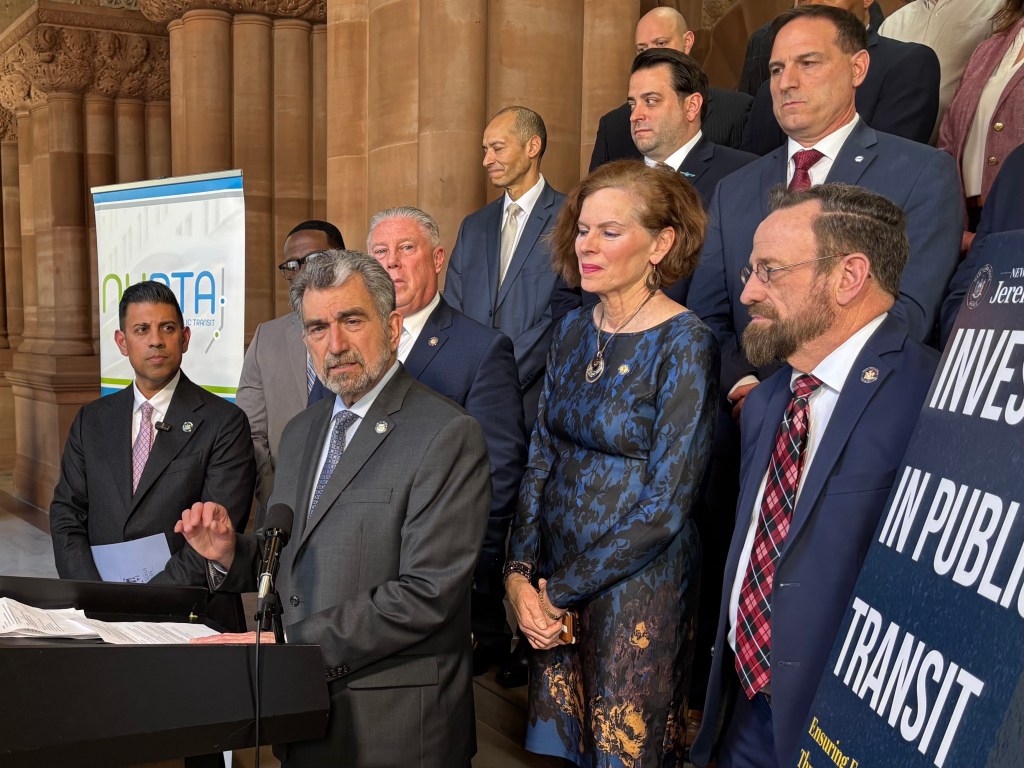
“Gas just went up almost $1 per gallon. Every pundit is saying it shows no signs of coming down anytime soon. Now, more than ever, we need alternatives to transit,” said state Sen. Pat Fahy (D–Albany) at a rally Wednesday. “So $52 million, if you think of the MTA budget, which many of us have supported over the years, that is a small comparison. Again, this is not to pick favorites. We support the funding because the strength of the New York City economy is based on the MTA. We contend it’s the same upstate here [and] for all of our regions.”
The governor’s proposed total state budget was $260 billion, and the MTA’s operating budget is $21.3 billion, for comparison. However, she’s claimed that despite the funding disparity, she’s committed to the issue and has made incremental funding increases for upstate transit over the years.
“Transit is vital to communities across New York, which is why Gov. Hochul has committed unprecedented financial support to transit agencies throughout the state so they can run better service and make it easier to get around without a car,” said Hochul spokesperson Sean Butler.
A proposal to create a new $25 vehicle registration surcharge outside of the MTA’s commuter zone to fund upstate transit has the backing of Assembly Member Bill Magnarelli (D-Syracuse) and state Sen. Jeremy Cooney (D-Rochester), the transportation chairs of their respective chambers.
Magnarelli introduced the legislation (A10431) earlier this month, and according to the bill text, the surcharge would generate $100 million annually.
But Hochul has repeatedly said she does not support the proposal, viewing it as another tax on New Yorkers, albeit only on the car-owning portion of the state’s population.
Nonetheless, Magnarelli said it’s “being discussed” among his colleagues in the Assembly.
“People are going to come around, because the idea that this is an affordability question, that people can’t afford that registration fee, flies in the face of the affordability that it’s going to make by putting it into our transit systems, and what it’s going to do for our roads, for our climate, for our people getting to where they have to go,” he said.

Read More:
Streetsblog has migrated to a new comment system. New commenters can register directly in the comments section of any article. Returning commenters: your previous comments and display name have been preserved, but you'll need to reclaim your account by clicking "Forgot your password?" on the sign-in form, entering your email, and following the verification link to set a new password — this is required because passwords could not be carried over during the migration. For questions, contact tips@streetsblog.org.