Op-Ed: Yes, Gov. Cuomo, Car Helmets Could Save Lives

City & State NY is hosting a full day New York in Transit summit on Jan. 30 at the Museum of Jewish Heritage. This summit will bring together experts to assess the current state of New York’s transportation systems, break down recent legislative actions, and look towards the future of all things coming and going in New York. Join Keynote Speaker Polly Trottenberg, commissioner of the NYC Department of Transportation, along with agency leaders, elected officials, and advocates. Use the code STREETSBLOG for a 25-percent discount when you RSVP here!
Streetsblog recently asked Gov. Andrew Cuomo “if he might consider helmet mandates for car drivers, given that vast numbers of car drivers who in fatal crashes die as a result of head trauma, as opposed to bicyclists, who are often killed in ways that would render a helmet useless.”
“I’m thinking,” the governor said after a long pause. “I don’t know enough. I’d like to see the data.”

Here you go, governor: the data exist, and they are truly scary. The American Association of Neurological Surgeons says about 1.7 million cases of Traumatic Brain Injury occur every year in the United States, and that “between 50-70 percent … are the result of a motor-vehicle crash.” They also note:
- Annual direct and indirect TBI costs are estimated at $48 to $56 billion.
- There are about 235,000 hospitalizations for TBI every year, which is more than 20 times the number of hospitalizations for spinal-cord injury.
- Every year, 80,000 to 90,000 people experience the onset of long-term or lifelong disabilities associated with TBI.
One would think, given those startling numbers, that helmets would be as ubiquitous in cars as seat belts, especially given research showing how effective they could be in injury prevention. Such studies exist, and they are impressive.
Mikael Colville-Andersen of the blog Copenhagenize points to an Australian study [PDF] in which researchers studied a protective headband that protects the most vulnerable part of the head. Per the study, “a headband for car occupants could significantly reduce the severity of certain head impacts in a crash.”
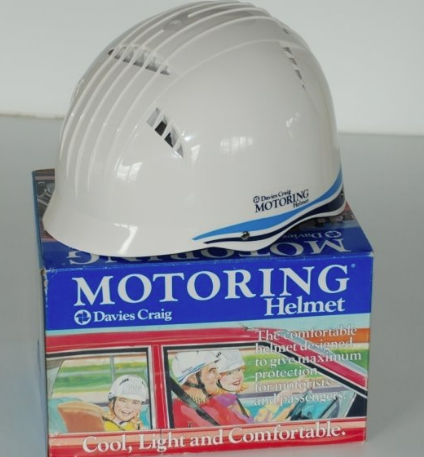
Australia is also the home of the Davies Craig Motoring Helmet, of which cycling writer and historian Carlton Reid is a proud owner. “Motoring is a dangerous activity,” Reid quotes the developer, Richard Davies, in Forbes. “If a motorist is not killed in a crash, one of the most common injuries is a head injury and they can produce permanent and long-term damage.”
Reid wonders why we are “culturally programmed to mollycoddle motoring.”
“Statistically, and logically, it would make sense to take every safety precaution necessary when driving, including wearing helmets — but no brain injury organizations lobby for their use, never mind their mandatory use,” Reid writes. “Unlike for cycling, there are no campaigns urging the adoption of motoring helmets because ‘if it saved just one life it would be worth it.’”
It would save a lot more than one life, and dramatically reduce the number and severity of traumatic brain injuries. Another Australian study concluded that mandatory use of helmets, like those sold by Davies Craig, would make a lot more sense than the mandatory bicycle-helmet laws they have in Australia:
“Despite the risk of dying from head injury per hour being similar for unhelmeted cyclists and motor-vehicle occupants, cyclists alone have been required to wear head protection,” the study’s authors observe, adding, “a mandatory helmet law for these road users has the potential to save 17 times as many people from death by head injury as a helmet law for cyclists without the adverse effects of discouraging a healthy and pollution free mode of transport.”
Mandating car helmets would be a struggle. The automotive industry fought the introduction of seat-belt laws for years, worried that they would make driving less enjoyable and reduce car sales. In fact, when Ford put seat belts in their ’56 cars and tried to market their cars as being safer, sales plummeted. Imagine how car companies would fight against mandatory helmets for drivers, which would probably depress driving rates, just like mandatory bike helmets did to cycling rates in Australia.
That’s why it is so exciting that Gov. Cuomo is willing to consider helmet mandates for car drivers. Imagine, taking action that would prevent thousands of injuries, save millions of dollars in health-care costs, reduce insurance rates, free up hospital beds and reduce congestion, all while being seen to take on a big, entrenched auto industry.
If you want data, we’ve got data.
Lloyd Alter (@lloydalter) is the design editor of treehugger.com.

Streetsblog has migrated to a new comment system. New commenters can register directly in the comments section of any article. Returning commenters: your previous comments and display name have been preserved, but you'll need to reclaim your account by clicking "Forgot your password?" on the sign-in form, entering your email, and following the verification link to set a new password — this is required because passwords could not be carried over during the migration. For questions, contact tips@streetsblog.org.