Rochester Residents Back Traffic Cameras Near Schools
Most Rochester residents don’t support automated traffic enforcement in principle, but a majority want speed cameras in school zones, according to a report released this month.
The report, prepared by the consultant TYLin, arrives nearly a decade after Rochester ended its red-light camera program amid complaints that it burdened the city’s poorest neighborhoods. The report culls the responses from five roundtable workshops this spring featuring a representative sample of 200 participants and an online survey of 1,370 people in July.
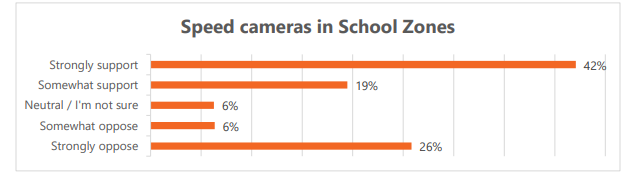
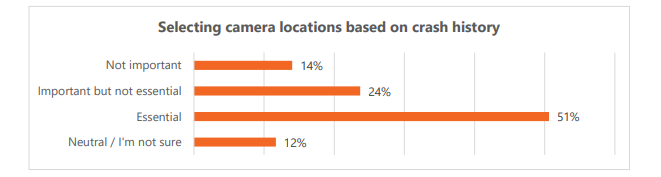
Fifty-seven percent of respondents said they don’t support automated enforcement overall, versus 37 percent who do. But drilling down, 61 percent said they supported speed cameras in school zones, 54 percent supported red-light cameras in school zones and 53 percent supported them at high-crash locations. About 77 percent supported school bus stop-arm cameras, which went onto Rochester City School District buses beginning on Nov. 3.
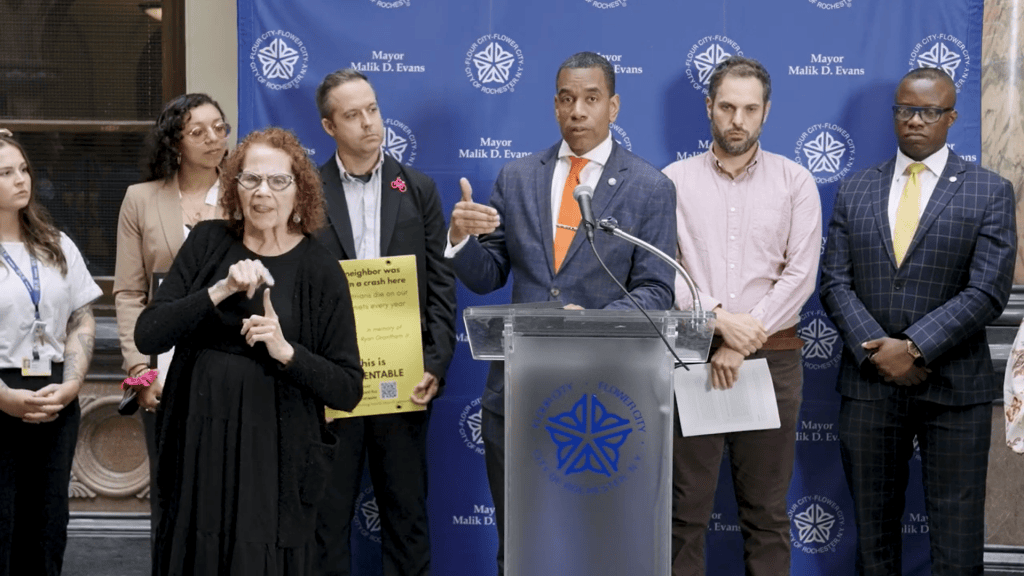
“There is a wide mixture of opinions about what the appropriate interventions are, but there is consensus that we have a crisis,” City Council Member Mitch Gruber, co-chair of the city’s Vision Zero Task Force, said on Wednesday at a presentation of the findings. “We cannot look at a crisis like this and try to please everyone.”
A city with a crash problem
Rochester averaged 9.6 traffic fatalities per 100,000 residents annually from 2020 to 2024, according to state Department of Transportation crash data. That’s higher than Buffalo (6.6), Syracuse (6.7), Albany (6.2) and Yonkers (3.3). The report says nearly one in four Rochester households has no car.
“Rochester has the dubious distinction of being one of the cities with the worst crash rates in all of New York State,” Mayor Malik Evans said on Wednesday. “We cannot and will not accept crashes as inevitable.”
Two pedestrians were killed on Lake Avenue this month, one on Oct. 5 and another on Oct. 13. In September, Reconnect Rochester installed a memorial on Bay Street for a man killed in a hit-and-run. Cody Donahue, the group’s co-executive director, has said an average of 13 pedestrians and cyclists are killed on Rochester streets every year.
Donahue said redesigns alone can’t match the urgency. “We’re talking about long-term street design changes that can take years and years while pedestrians are dying on Rochester streets right now,” he said Wednesday.
Lessons from the last program
Rochester’s red-light cameras ran from October 2010 until the end of 2016, when the City Council voted to turn off the cameras after then-Mayor Lovely Warren said they hit residents of the poorest ZIP codes hardest.
The safety of cameras is clear: TYLin’s report says crashes at camera-equipped approaches fell 20.9 percent. But Warren claimed that a city-commissioned study was inconclusive because violations fell at some intersections and rose at others.
Workshop participants worried cameras would fall hardest on low-income residents and communities of color. They suggested warnings, education courses or fee waivers as alternatives to fixed fines. Donahue said his organization wants the process “rooted in community voice to inform what is an equitable and fair system that ultimately changes drivers’ behavior.”
Three cameras, three legal situations
In Rochester, bus stop-arm cameras are the only kind that can operate today, thanks to a state law allowed them since 2019 (and the city implementing them).
School zone speed cameras are different. New York State has to enact separate laws to allow them, as lawmakers have done for New York City, Albany, Syracuse and other cities. Rochester has not sent the necessary home-rule message to the state Legislature seeking Albany’s authorization.
But TYLin’s report says the city could start a school zone pilot program without seeking additional legislative authority.
Survey respondents set conditions. Eighty-three percent demanded a clear appeals process. Sixty-seven percent called for publicly announcing camera locations, and 58 percent supported a warning period before citations begin. Seventy-five percent said restrictions on how camera data is used are essential or important.
Privacy was a recurring worry, but as Streetsblog has reported, vehicles are only photographed when a violation is triggered.
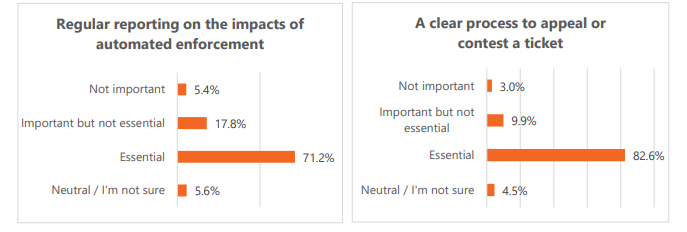
TYLin also recommends a public dashboard, a 30- or 60-day warning period, an equity assessment of camera placement and a post-pilot evaluation. It cautions against vendor contracts that pay by the citation.
What other cities have learned
New York City’s school-zone speed cameras have cut average daily violations per camera by 94 percent, and there were 14-percent fewer injuries and deaths where cameras were installed in 2022 compared to similar non-camera sites, according to the city’s Department of Transportation. Syracuse issued more than 60,000 warnings in the first two weeks of its program, nearly all for speeding, and warnings fell about 41 percent over the next two weeks.
The report doesn’t commit Rochester to anything, but Evans said the next step is to turn research into action.
“We have to move beyond just the acquisition of it to the application of it,” he said. “How are we going to apply what we learn to bring greater changes to make sure that we have fewer crashes, safer routes for people to ride bicycles, and places to walk that are safe?”

Read More:
Streetsblog has migrated to a new comment system. New commenters can register directly in the comments section of any article. Returning commenters: your previous comments and display name have been preserved, but you'll need to reclaim your account by clicking "Forgot your password?" on the sign-in form, entering your email, and following the verification link to set a new password — this is required because passwords could not be carried over during the migration. For questions, contact tips@streetsblog.org.