Poll Shows Huge Support for Apartments Near Transit As Hochul, Blakeman Debate Housing
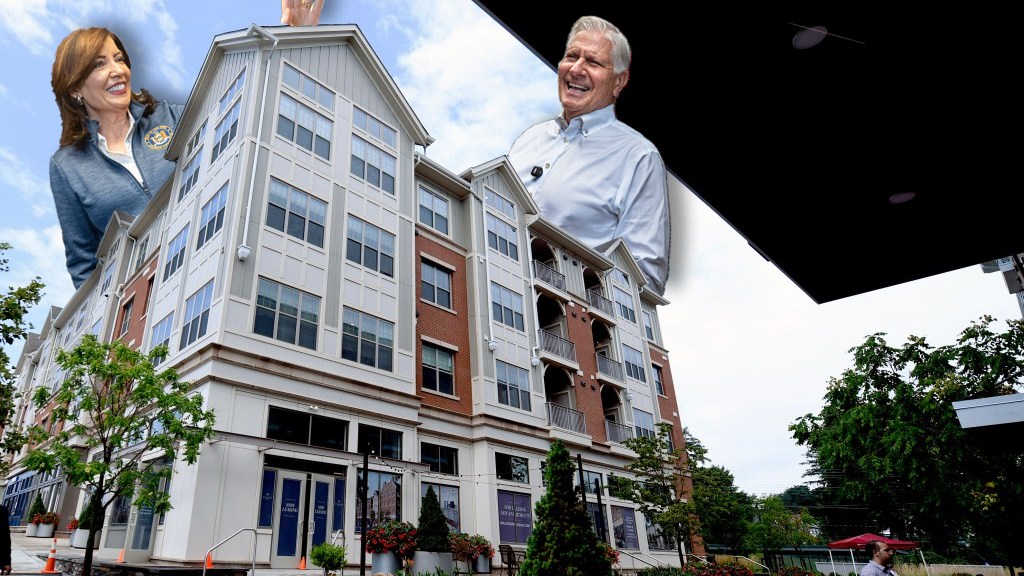
Nearly four-in-five New York voters support building more multi-family housing near rail stations, according to a poll commissioned by the pro-housing group Open New York — as Gov. Hochul and her Republican opponent stake out radically opposing positions on housing.
Global Strategy Group surveyed 600 likely general-election voters from Aug. 31 to Sept. 6, with a margin of error of plus or minus 4 percentage points, on several proposed housing-related reforms. Overall, 79 percent supported multi-family homes near transit and 19 percent opposed it — the highest support for any of the items tested. The poll found majority support for apartment construction near transit across party lines, regions, and among both homeowners and renters.
“New Yorkers are telling us something simple: they want to live near the train and near their jobs, and too many of them can’t afford to,” Open New York Executive Director Annemarie Gray said in a statement.
Nassau County Executive Bruce Blakeman, the Republican candidate for governor, has positioned himself strongly against effort to allow more housing construction, multi-family or otherwise. He did so again on Tuesday when the two pols met for their first and only head-to-head debate on NY1/Spectrum News.
When Hochul expressed remorse that she hadn’t fought harder for more housing construction when she first took office, and criticized Nassau County’s resistance to it, Blakeman actually bragged that his opposition to Hochul’s reforms had driven up the cost of housing in his county.
“If you bought a house four years ago in Nassau County for $600,000, it’s now worth $850,000 because of my policies. I have created a quarter of a million dollars in wealth for you and your families,” Blakeman retorted — framing the high cost of housing as a plus.
In 2023, Blakeman warned of a “suburban uprising” if Hochul imposed land-use rules on localities. Yet Open New York’s survey found a majority of Long Island voters — 53 percent — support giving the state the ability to override local leaders in order to build more housing. Seventy percent of Long Island voters support housing near rail stations.
Advocates for more housing construction pounced on the Republican’s admission that his policies deliberately intended to inflate the cost of housing.
“Amazing,” Gray, Open New York’s executive director, quipped on X. “Blakeman brags about building the lowest number of homes in the nation and raising the price of housing by over 41% in 4 years, while Hochul is (rightly) proud of taking on hard fights to build more and actually work to bring down housing costs for NYers.”
The strong polling for multi-family transit-oriented development could help nudge Hochul to revive her dormant 2023 effort to require higher density around rail stations. With transit-oriented zoning off the table, Open New York instead spent this year pushing for reforms to the state’s environmental review process that Hochul signed into law on May 27.
Those reforms exempted certain housing, parks and trails from the state environmental review process. The poll found lighter environmental review was more popular among voters who live within walking distance of a train station, 84 percent to 15 percent, compared to 70 percent to 28 percent among those who don’t.
Support for multi-family housing was strong in the poll regardless of partisan affiliation: Democrats backed permitting apartments near transit by a whopping 87 percent to 11 percent, independents 76 percent to 23 percent and Republicans 68 percent to 30 percent. Homeowners (78 percent to 21 percent) and renters (79 percent to 16 percent) showed practically the same levels of support. And voters who live within walking distance of a station were as supportive as those who don’t, 78 percent compared with 80 percent.
Open New York’s pollster did not ask voters about specific projects, but the survey comes as the state pitches housing along the Interborough Express corridor and on MTA-owned sites.
In lieu of transit-oriented zoning reform, Hochul’s administration has moved to develop on transit-adjacent land the state already owns. The MTA board approved a developer last July to turn a parking lot at the Beacon Metro-North station into 265 mixed-income homes, paid for by a state fund dedicated to repurposing state-owned land for housing.
The poll found that housing costs are pushing New Yorkers farther from their jobs. Nineteen percent of voters said their commute is longer than they want because they can’t afford to live closer to their job, rising to 33 percent in New York City’s outer boroughs and 30 percent among renters.
“Building new housing near public transit is one of the most effective ways to make New York more affordable in the years and decades to come,” said Ben Furnas, executive director of Transportation Alternatives. “If you have to own a car to get to work, you’re paying an average of $9,000 a year in vehicle expenses — a financial burden that’s getting even heavier as gas prices skyrocket. We can lift this burden for New Yorkers and prevent them from getting priced out of our city by building new train lines like the IBX, and by building dense housing next to train stations.”

Read More:
Streetsblog has migrated to a new comment system. New commenters can register directly in the comments section of any article. Returning commenters: your previous comments and display name have been preserved, but you'll need to reclaim your account by clicking "Forgot your password?" on the sign-in form, entering your email, and following the verification link to set a new password — this is required because passwords could not be carried over during the migration. For questions, contact tips@streetsblog.org.