State Bill Would Eliminate Parking Minimums in the City

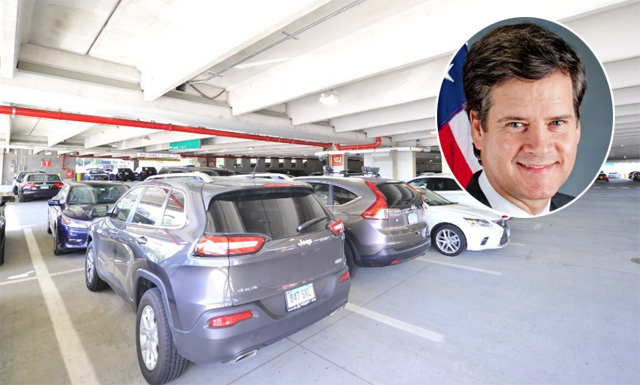
The state legislature may finally eliminate mandatory parking minimums in the five boroughs — the pro-car zoning rule that forces developers to include a set number parking spaces in many new buildings across the city and contributes to congestion, pollution, and higher housing and construction costs that are passed along to tenants.

The proposed legislation by state Sen. Brad Holyman (D-Manhattan) would “prohibit cities…from requiring construction of off-street parking” in an attempt to encourage public transit and reduce car ownership at a time when scientists say human activity is speeding up climate change faster than previously anticipated, Hoylman said.
“How backwards is it in this day and age, while trying to promote mass transit and alternate modes of transportation, to have mandatory minimums for the automobile,” he said. “That was the inspiration, to really attack the Robert Moses approach to infrastructure.”
The proposed bill, introduced in Albany last month, is also part of a larger push to build more much-needed affordable housing across the city, Hoylman said.
“Basically everywhere there’s a mandatory minimum for parking, that could be housing,” said Hoylman. “I’ve heard from my constituents, as have my colleagues, we’re in the middle of a housing crisis, and we have to pass policies and fund programs to build more lower-incoming housing, and mandatory parking minimums are a clear impediment to that goal.”
The bill would not stop developers from building parking if they chose to, according to Holyman. Plenty of developers don’t like the mandatory parking requirement, especially in projects near transit or in neighborhoods with low car ownership; they would prefer to use that space for amenities that residents want, or to include below-market-rate units.
Gov. Hochul in her State of the State earlier this month similarly unveiled a plan to encourage density by giving the city the authority to repeal an existing state law that limits the current maximum residential building floor-area ratio — a measurement of how large a building can be relative to the size of the land it is on — to 12. The floor-area ratio of non-residential buildings is not subject to such limitations.
Hochul, who used the word “antiquated” in describing that zoning law, didn’t discuss eliminating parking minimums, but she did address the need to “spur transit-oriented development” — and the two are intimately connected, Hoylman said.
Forcing developers to require parking often means higher construction costs through excavation work and additional square footage that then gets passed onto the residents, even the more than half who don’t own a car.
A former president of the Downtown Brooklyn Partnership, and now head of Brooklyn-based real estate development firm Totem, told Streetsblog back in August that the added cost of including parking could instead go towards providing space that benefits everyone.
“Most people put parking underground, it costs money to excavate to put parking there. That money can be spent on other things: more affordable housing, more community space,” said Tucker Reed.
Currently, in the city, there are no parking minimums in Manhattan below 96th Street on the East Side and below 110th Street on the West Side (in response to the 1970 Clean Air Act); they’ve been relaxed in Downtown Brooklyn and parts of Long Island City; in 2016, the city’s Zoning for Quality and Affordability plan eliminated parking minimums for fully affordable housing developments in transit-rich areas; and as part of neighborhood-wide rezoning plans such Inwood, the city also lowered or eliminated parking minimums for all new developments.
Still, while the arcane zoning code remains on the books at all, developers are tasked with reducing the number of parking spots on their own. For example, in transit-rich Downtown Brooklyn, the real-estate firm Alloy Development had to jump through hoops to get permission to nix the parking requirements for its planned mega-project — dubbed the Alloy Block (formerly known as 80 Flatbush) — at the junction of Flatbush Avenue, Schermerhorn Street, Third Avenue and State Street.
Under existing zoning laws, Alloy was required to include 200 parking spaces, which the builders hoped to not provide, citing the worsening climate crisis, existing congestion in the area, and the building’s proximity to many transit lines. The developers eventually won the right to include no parking, but it was a long, expensive, and difficult process, according to Alloy CEO Jared Della Valle.
A spokesperson for the Department of City Planning previously told Streetsblog that a wholesale elimination of parking minimums across the city would require a lengthy review process known as the Uniform Land Use Review Procedure involving all 59 community boards and the five borough presidents, then a vote from the city council; it would also require an extensive environmental review of the effects of such a change.
If Hoylman’s legislation becomes law, the city will have 180 days to bring its zoning laws into compliance, according to a spokesperson for the pol’s office. State Sen. Alessandra Biaggi (D-Bronx) has also hinted at introducing a bill that would nix the city’s parking minimums requirements in new developments, but she declined to comment at this time.
It’s unclear if a land-use review procedure would still be required. A spokesperson for City Planning said the agency will review the legislation. A spokesperson for Hochul told Streetsblog that the governor will review the legislation if it passes.

Julianne Cuba joined Streetsblog in February, 2019, after three years covering local news and politics at The Brooklyn Paper. There, she also covered the notoriously reckless private carting industry and hit-and-runs. A 2015 graduate of Stony Brook University’s School of Journalism Master’s Program, she lives in Brooklyn. Julianne is on Twitter at @julcuba. Email Julianne at julianne@streetsblog.org
Read More:
Streetsblog has migrated to a new comment system. New commenters can register directly in the comments section of any article. Returning commenters: your previous comments and display name have been preserved, but you'll need to reclaim your account by clicking "Forgot your password?" on the sign-in form, entering your email, and following the verification link to set a new password — this is required because passwords could not be carried over during the migration. For questions, contact tips@streetsblog.org.