Yesterday’s Times Square Toll Was Terrible — But So Is a Typical Day of NYC Traffic Violence

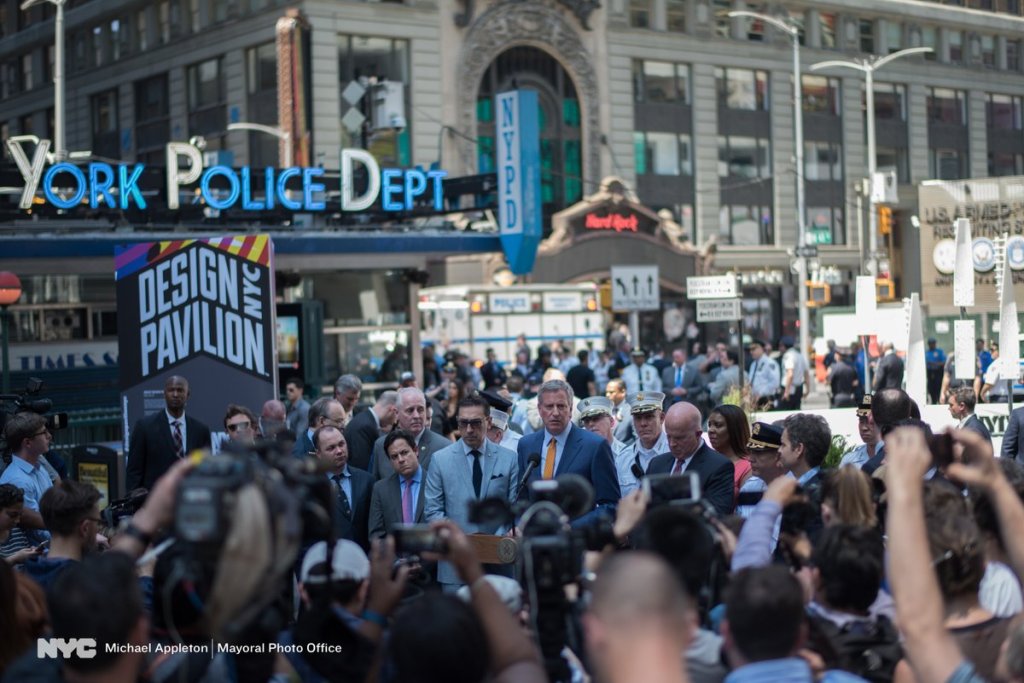
Within half an hour of Thursday’s noontime motorist rampage in Times Square, Governor Cuomo was on the scene. At 1:30 p.m., Mayor de Blasio convened a press conference with Police Commissioner James O’Neill and Fire Commissioner Daniel Nigro, confirming the awful toll: one person killed and 22 injured, with four victims in critical condition.
Given the high-profile location, the number of victims, and recent instances of people using vehicles to kill for ideology, it’s understandable that yesterday’s crash drew so much attention. But it’s important to recognize that as terrible as the Times Square carnage was for a single incident, the same human toll occurs on a daily basis on NYC streets — it’s just dispersed across the city.
Through the end of April, motorists injured 3,411 people walking in New York City — or 28 people a day, on average — according to city data. Drivers in NYC have killed no fewer than 49 people on sidewalks and inside buildings since 2012, according to crash data tracked by Streetsblog.
On WNYC this morning, de Blasio signaled a willingness to examine pedestrian safety measures in Times Square and other locations. “[W]e’re going to look at Times Square and see — obviously we’ll look at some other key locations — if we have to do different things in our approach,” said de Blasio. “We’re going to make decisions case by case, but we take this very, very seriously.”
While the city should take steps to protect pedestrians at crowded places like Times Square, there’s a risk that too much energy will go into addressing the specific circumstances surrounding this high-profile but unusual event, as opposed to the more routine traffic violence around the city that adds up to hundreds of lives lost each year.
Fortunately, we know what causes traffic injuries and deaths, and how to address it. The problem is that there are too many cars in our neighborhoods, and too many drivers traveling at lethal speeds. A surface transportation system with fewer cars, each traveling at non-lethal speeds, will be much safer — and it’s very achievable.
Right now, the single most important policy on the table to prevent traffic deaths is in Albany’s hands. Governor Cuomo, who issued a brief statement of condolence yesterday, has the power to sway state legislators to let NYC expand its life-saving speed camera program. Speeding, a leading cause of fatal traffic crashes, drops by 60 percent where cameras are deployed, and traffic deaths in the city have fallen substantially since the automated enforcement program launched in 2013. Yet lawmakers including Marty Golden continue to stand in the way of a bill to expand automated speed enforcement while Cuomo remains silent.
At the city level, the de Blasio administration continues to take one step back for every two steps forward. City Hall’s recent decision to issue tens of thousands of new parking placards is a case in point — handing out parking perks will increase traffic risk, cutting against the grain of the city’s Vision Zero initiatives.
And as much as NYC DOT has done to design streets for greater safety, most plans to prioritize human life remain subject to being watered down or rejected for the sake of perceived motorist convenience.
In a Daily News op-ed published today, Transportation Alternatives Executive Director Paul White urged the mayor to put safety projects ahead of politics:
To prevent further loss of life, in the wake of yesterday’s tragedy we must realize that it was the controversial street safety improvements applied to Times Square in recent years — including wider sidewalks protected with steel and concrete bollards — that prevented the tragedy from being far worse.
These types of pedestrian safety measures, even now still sometimes opposed by drivers, must be urgently applied on all streets without interminable community process. Just as we do not debate the merit of using modern infrastructure to separate our sewage and water to prevent cholera, we should not argue over the merit of proven, life-saving design and enforcement.
White joined City Council Member Ydanis Rodriguez, State Senator Brad Hoylman, the Daily News editorial board, and others in calling for more traffic-calming on city streets.
It’s critically important that NYC pursue these street safety strategies without resorting to the heavy-handed fencing and barriers that NYPD put up all over lower Manhattan after 9/11. Bulky barricades hemming people in on every sidewalk to keep cars out would be a visual symbol of “taking action,” but not much more than a symbol.
The right response to this high-profile rampage isn’t a highly visible spree of security theater. It’s the politically brave and often thankless work of reshaping streets across the city with narrower roadways, wider sidewalks, and other measures that make high-speed car travel unthinkable.

Read More:
Streetsblog has migrated to a new comment system. New commenters can register directly in the comments section of any article. Returning commenters: your previous comments and display name have been preserved, but you'll need to reclaim your account by clicking "Forgot your password?" on the sign-in form, entering your email, and following the verification link to set a new password — this is required because passwords could not be carried over during the migration. For questions, contact tips@streetsblog.org.