Cuomo’s Green Agenda Comes Out Swinging for Smart Growth


Last Friday, Andrew Cuomo released his green agenda, the final installment in a series of policy papers his campaign published over the last few months. In it, Cuomo strongly endorses smart growth and suggests the creation of a competitive grant program to encourage better planning. He also expresses his support for high speed rail, public transit, biking and walking, and electric cars, though those positions aren’t always backed up with actionable initiatives.
If, as expected, Cuomo defeats Carl Paladino in today’s election, the initiatives laid out in this agenda will provide a hint of what’s to come from the governor’s mansion over the next four years.
“There’s a potential for a lot of good policy,” said Tri-State Transportation Campaign director Kate Slevin. “Overall, it’s good to know that he’s trying to marry environmental issues and capital investments.” The worry, she said, is that beyond a few initiatives like the smart growth grants, it’s not always clear how Cuomo would turn his priorities into policy. “The question that many of us are asking is how all these good ideas are going to translate into action after today.”
The anti-sprawl argument in the green agenda is powerfully expressed: “Sprawling communities have a higher per capita use of energy, land and water, and every year encroach on 97,245 acres of farmland and open space. Unplanned, sprawling development is bad for commuters, taxpayers and the environment everywhere, but particularly in Upstate New York.” And the conclusion is clear. “Simply put: we need to have better land use plans.”
To switch from wasteful and environmentally destructive sprawl to smart growth, Cuomo has a few solutions. He praises the recently-passed smart growth bill and vows to enforce it, saying that “strong leadership is needed to effectively implement these smart growth principles.” As a first step, Cuomo suggests streamlining regional planning by eliminating the overlap between local and county planning agencies.
The green agenda also proposes a new “Cleaner, Greener Communities” grant program, presumably modeled on the federal Sustainable Communities program recently launched by the federal agency Cuomo used to run, HUD. Under the program, the state would award funding to regions with the best plans for coordinating housing, transportation, and environmental policies.
“Empire State Future is pleased to see the prominence and importance given to smart growth in the about-to-be-Governor-Elect’s Green Agenda,” said Peter Fleischer, that organization’s director and a leading smart growth advocate. “We agree that the indivisible concept of sustainable community and economic development is the precursor to New York’s revitalization.”
A full chapter of the report is devoted to sustainable transportation, in all its forms. “Transportation planning and regional development is no longer just about building roads and bridges,” Cuomo asserts. He connects a strong public transit system to both economic prosperity and environmental sustainability. “Advancements in sustainable development, urban renewal, and environmental conservation will falter or reverse if New York neglects its public transportation infrastructure,” says Cuomo’s agenda.
Of course, supporting transit in the abstract is valuable only insofar as it leads to concrete support for transit. And there, Cuomo’s stated positions are practically in conflict with these lofty ideals. He’s ruled out new revenue for transit, despite the fact that state transit funding has plummeted over the last 25 years and put transit agencies across New York in dire fiscal straits. He’s also spent his time bashing the state’s largest transit agency, the MTA, rather than offering constructive solutions.
Cuomo also lays out the case for pedestrian and bicycle infrastructure. “Sidewalks and bike paths provide the critical link to our transit systems,” the report says, “and provide alternatives to conventional gas vehicles. Half of all trips in metropolitan areas are three miles or less, and over a quarter are a mile or less.” He urges all state transportation agencies to “consider” features like bike lanes, crosswalks, and walk signals “to ensure New York’s streets are complete.” While that language is a bit vague, Cuomo endorsed state complete streets legislation, which failed to pass the Assembly this year, in an AARP survey this fall.
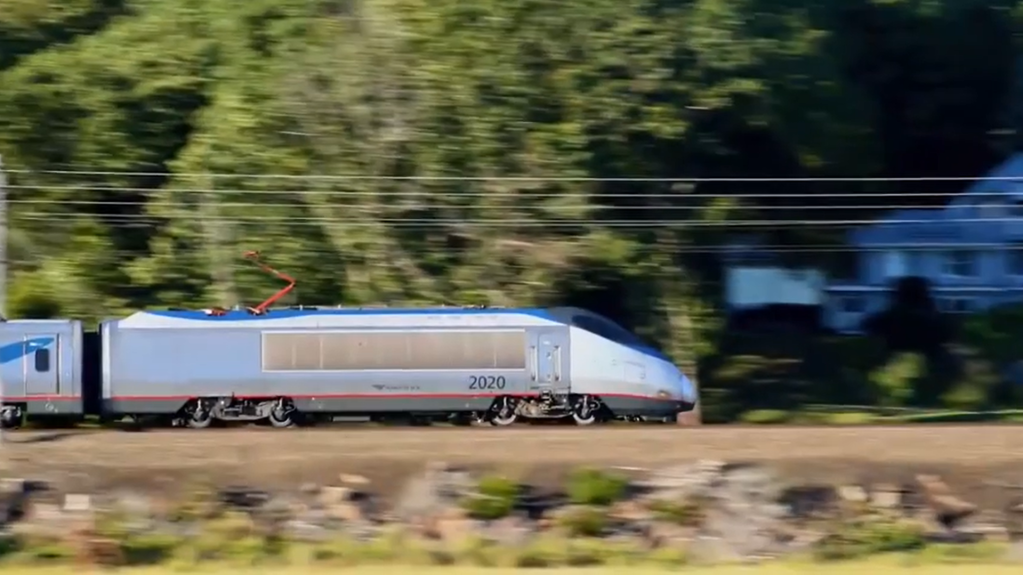
In one section, Cuomo promises to build a rail system that can average 100 mph between New York City and Albany and Albany and Buffalo, and eventually connect at high speeds with Toronto and Montreal. He also pledges to build the charging infrastructure needed for electric cars to be widely adopted, suggesting that charging stations be placed along the Thruway and other major state roads, and at commuter rail parking stations.
One thing Slevin said she’d have liked to see more of is discussion of how to reform the state DOT itself. “The agency is stuck in a 20th Century planning mode and we really need more vigorous leadership from the department,” she said. With a progressive state DOT, she argued, officials would fight for the priorities laid out in Cuomo’s green agenda without prodding from the governor’s office.

Read More:
Streetsblog has migrated to a new comment system. New commenters can register directly in the comments section of any article. Returning commenters: your previous comments and display name have been preserved, but you'll need to reclaim your account by clicking "Forgot your password?" on the sign-in form, entering your email, and following the verification link to set a new password — this is required because passwords could not be carried over during the migration. For questions, contact tips@streetsblog.org.