If You Can’t Take the Stairs, Only 23 Percent of Subway Stations Are Accessible — on a Good Day
For mobility-impaired New Yorkers, riding the subway can be impossible. Only 110 of the system’s 472 stations have stair-free access, and even at those stations, elevators don’t serve every platform and are often out of commission, with little or no public notice.
The MTA is on pace to fulfill its commitment under the Americans with Disabilities Act to make 100 “key stations” accessible by 2020. (There are 11 of these stations left to go.) But beyond that, the agency has no subsequent plan for improving accessibility. Governor Cuomo is remodeling 31 stations in the system, but not for ADA-compliance.
Disability rights advocates have had enough. They’re calling on the MTA to prioritize accessibility for the 10 percent of New Yorkers who have a disability as Cuomo and MTA chair Joe Lhota work out a plan to turn around subway and bus service.
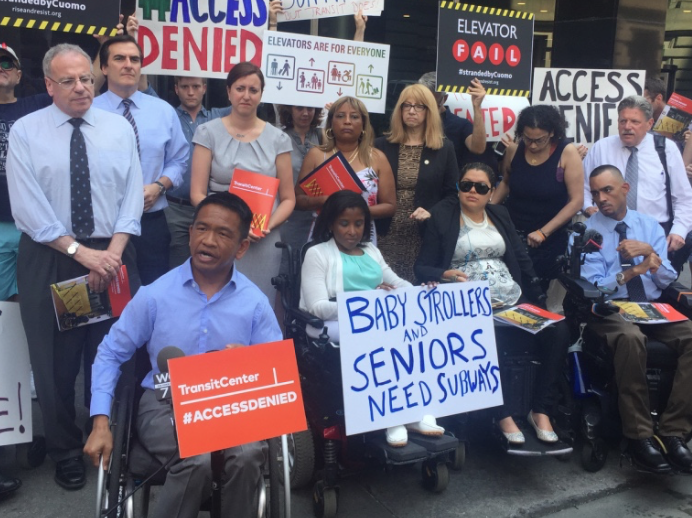
“Nearly 30 years after the passage of the Americans with Disabilities Act, the MTA operates the least accessible subway system in the country,” TransitCenter program director Chris Pangilinan said today at a rally outside MTA headquarters.
Pangilinan, who uses a wheelchair, is one of the plaintiffs in a federal lawsuit charging the MTA with discrimination against people with disabilities. He said he’s faced an elevator outage every four days since moving to the city two years ago. “The 100 stations are merely a box to check for the MTA, and then they get to go home. Meanwhile, the rest of us up here are still stranded underground,” he said.
“Access Denied,” a report released today by TransitCenter, highlights the subway’s accessibility crisis and sets forth steps the MTA must take to address it [PDF]. According to the report, from July 2014 to June 2015, an average of 25 elevator outages occurred each day, with no less than seven and as many as 46 occurring on a single date. The worst offenders were the Yankee Stadium and Franklin Avenue stations, which had elevator outages on 111 and 97 days, respectively.
Since there are no real-time updates on the status of elevators, riders unable to climb stairs must spend hours figuring out how to get out of the system and get home.
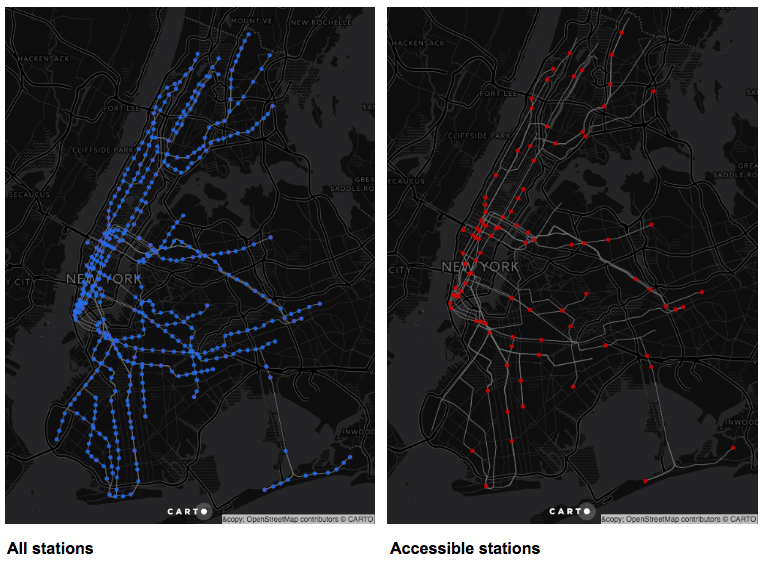
Because of the lack of elevators, riders in wheelchairs have access to just 5 percent of the possible point-to-point trips available to able-bodied riders.
This morning, Pangilinan and other wheelchair-using riders, holding signs with messages like “My elevator stood me up” and “#strandedbyCuomo,” shared horror stories of hours spent going from station to station looking for a way in or out. “These experiences rob us of our dignity and are an urgent concern for the disability community,” said Monica Bartley, community outreach specialist for the Center for the Independence of the Disabled, New York.
Station accessibility is not only a concern for the disabled, but also seniors and parents with strollers. The city’s population age 65 and older is expected to grow 36 percent by 2030, making station accessibility even more urgent for the city’s future.
The coalition behind “Access Denied” is calling on the agency to make every station ADA-accessible, which even at an accelerated rate of 15 stations per year would take two decades. And they want the agency to improve the pace of maintenance while providing real-time information on elevator outages. To oversee these efforts, they’re calling for the MTA to create a high-level department dedicated to addressing accessibility needs across the system.
New York’s subway system may be old, but that’s no excuse. The TransitCenter report notes that transit agencies in Chicago and Boston, also faced with century-old infrastructure, set out to achieve 100 percent accessibility. Boston is now at 71 percent and Chicago at 69 percent — much farther along than the MTA.
“We want to see a timeline with real goals, including a plan for handling elevator outages, repairs, and notifying customers of travel alternatives,” Bartley said.

Read More:
Streetsblog has migrated to a new comment system. New commenters can register directly in the comments section of any article. Returning commenters: your previous comments and display name have been preserved, but you'll need to reclaim your account by clicking "Forgot your password?" on the sign-in form, entering your email, and following the verification link to set a new password — this is required because passwords could not be carried over during the migration. For questions, contact tips@streetsblog.org.