KOMANOFF: Want Fair Taxi Congestion Surcharges? Embed Them Within Congestion Tolling

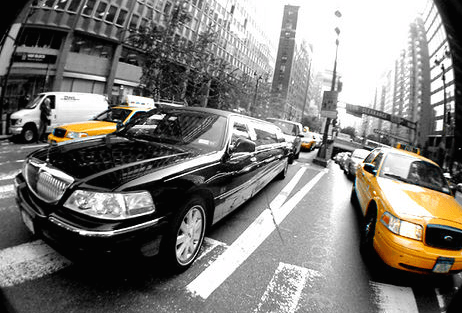
Streetsblog contributor Charles Komanoff presented the following testimony on Monday morning at a hearing of the City Council Committee on For-Hire Vehicles. Komanoff is an internationally recognized expert on congestion pricing, but is also a consultant — in this case for a taxi-medallion owner. He was testifying on Intro 1302-2019, which would require a minimum base rate for trips dispatched by Uber and Lyft, but used that bill as a springboard to outline why and how for-hire vehicle congestion-surcharging should be done as part of congestion-tolling. Here are his remarks:
I fully support the intent of Intro 1302-2019, but recommend that the Council and the Legislature go considerably further.
There are many equities to be balanced in setting policies governing for-hire vehicles: between yellow cabs and the app-based vehicle sector, which compete for the same business; between both classes of for-hire vehicles and private cars and trucks, which vie for the same road and street space; and between all motor vehicles and public transportation, whose uneasy relationship — competitive at times, but sometimes mutually supportive — is about to be made more tangled by congestion pricing.
Balancing these equities would be challenging in the best of times, which these are not. The app-based companies, Uber and Lyft, are decimating the taxi industry. Financial losses are endemic, and in the past year-and-a-half eight taxicab drivers have taken their own lives. The city’s subways and buses are hemorrhaging riders and money. And the Manhattan core is more gridlocked than at any time in memory, in large part because thousands of drivers for Uber and Lyft spend so much time “trawling” for business — hanging out in the Manhattan taxi zone waiting to be pinged.
For-hire vehicle drivers want to survive. Motorists and truckers want to move and deliver. Transit users want subways that work and buses that aren’t stuck behind car traffic. Patrons of cabs, Ubers and Lyfts want to be picked up promptly and to arrive on time. People on foot and riding bikes want fewer vehicles. And, to repeat, drivers of for-hire vehicles want to survive.
I believe we can advance all of these aims simultaneously with this five-point plan:
- Albany rescinds its flat-fee congestion surcharges on for-hire vehicles. (I’m referring to the intended Jan 1, 2019 surcharges that have been stayed by the temporary restraining order.)
- New York City mandates and implements “connectivity” for app-based vehicles (taxis have it already).
- Albany enacts congestion tolls on private cars and trucks.
- During the run-up to congestion tolls, Albany phases in time-based congestion surcharges, including trawling charges, on app-based vehicles.
- Albany enacts congestion surcharges on taxis, which only go into effect when congestion tolling is in place.
Here’s why this program is fair:
- Connectivity for app-based vehicles is fair because it’s easy, it’s inexpensive, and it will ensure that the app-based companies comply fully with city regulations and state surcharges.
- Charging all motor vehicles to travel to or within the Manhattan CBD is fair since all motor vehicles contribute to congestion. (While today’s technology doesn’t let us toll or surcharge private cars and trucks that don’t enter or leave the CBD, that is a pity but not a show-stopper, since these vehicles account for only 10 percent of CBD traffic.)
- It is fair to refrain from fully surcharging taxis and app-based vehicles until private cars and trucks pay tolls to enter the CBD. Only congestion tolls will give FHV’s an opportunity to recoup the business they will lose from the surcharge with business they will gain from faster traffic.
- Phasing in congestion surcharges only for the app-based vehicles is fair because taxis have already paid for the right to operate in the taxi zone — a right they reasonably expected to hold in perpetuity — and because their numbers are capped by statute, and at just one-seventh of the putative city cap on the app-based vehicles.
- Surcharging all FHV trips based on their time in the taxi zone is fair because it ties the surcharge to “congestion causation,” with trips that impose the greatest costs being charged the most.
- Imposing an additional “trawling surcharge” on app-based FHV’s is fair because FHV trawling is a socially useless activity that is best addressed by making Uber and Lyft pay a price for it.
Here is what fair and effective congestion tolling and surcharging might consist of:
- Cars and trucks pay the higher-range cordon tolls outlined a year ago in the Fix NYC report.
- Once cordon tolls are in place, all FHV’s are surcharged at $0.40 per each minute with a fare in taxi zone.
- App-based FHV’s are additionally surcharged for trawling time in the taxi zone at 60 percent of the rate with a fare.
- All surcharges are discounted by 50 percent on weekends and 8pm-6am weekdays.
Here is what those tolls and surcharges would achieve, according to my traffic modeling:
- 15 percent faster travel in the CBD (more, once the congestion revenues are invested in better transit).
- Roughly $1.7-$1.8 billion a year in new net revenue for better transit, of which $300 million will come from taxi surcharges and $475 million from Uber surcharges.
- Manhattan residents, who will benefit the most, will pay the biggest share of the new tolls and surcharges — more than Brooklyn and Queens residents combined.
- The number of trips in yellow cabs is unchanged or rises slightly.
Note: Results at end were obtained by inputting scenario outlined into the author’s Balanced Transportation Analyzer spreadsheet (Excel file). Some assembly required.

Charles Komanoff is a national expert on congestion pricing and traffic modeling, and is the former head of Transportation Alternatives. He is a longtime Streetsblog contributor. Reach him at komanoff@gmail.com.
Read More:
Streetsblog has migrated to a new comment system. New commenters can register directly in the comments section of any article. Returning commenters: your previous comments and display name have been preserved, but you'll need to reclaim your account by clicking "Forgot your password?" on the sign-in form, entering your email, and following the verification link to set a new password — this is required because passwords could not be carried over during the migration. For questions, contact tips@streetsblog.org.