MTA Can’t Borrow Its Way Out Of Hochul’s Capital Plan Gaps: Comptroller
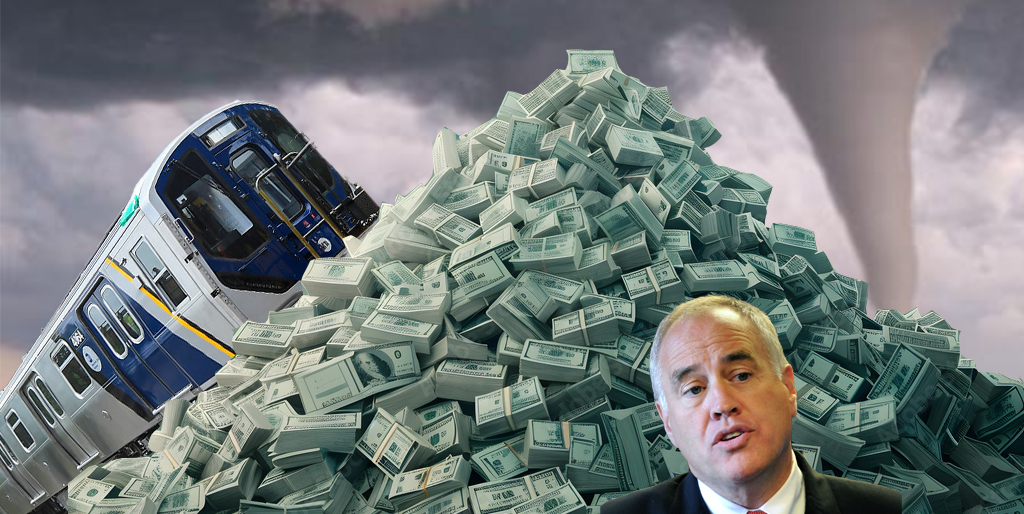
The MTA can’t take on any more debt to fill the hole in the current 2020-2024 or the upcoming 2025-2029 capital plan without dramatically jacking up fares or cutting service, a new report from the state comptroller warns.
As the MTA waits to see how Gov. Hochul fills the $15 billion hole she opened in the current capital plan and explains how she’ll fill the $33-billion hole in the next capital plan, state Comptroller Tom DiNapoli is warning that the transit agency can’t take care of either of those funding gaps itself while also keeping debt payments at a reasonable level.
Borrowing the $15 billion needed for the current capital plan with fare-backed bonds instead of with the long-expected congestion pricing money could hit riders with a whopping 16-percent fare hike years down the road, since the MTA is already planning on taking out $13 billion in the same kind of debt to fund some of the 2025-2029 capital plan.
“Filling the $15-billion funding shortfall for the 2020-2024 capital program … as well as bonding $13 billion as proposed for the 2025-2029 program would increase debt service by $2.4 billion between 2023 and 2037, reaching $5 billion that year,” DiNapoli wrote in a report analyzing the MTA’s financial position. “Assuming all other projections remain on their current trajectory … the cost of servicing this debt would necessitate the equivalent of raising the subway fare by 16 percent in 2037.”
The agency might have to look at fare hikes or service, DiNapoli notes, because the MTA is trying to keep future debt service payments to 15 percent of its operating budget, which already means sending 15 cents of every dollar from fares to pay off debt. Keeping up with that goal would mean the agency would need to find almost $11 billion in additional revenue between 2025 and 2037 through state support, additional ridership or fare and toll hikes.
“If the MTA bonded another $15 billion in addition to $13 billion for the 2025-2029 capital program, in order to reach the MTA’s goal of a debt burden of 15 percent, operating revenues would have to increase by $10.7 billion (4.5 percent annually) during that period. Unless alternative operating revenues can be identified to fill these gaps, the MTA will have to turn to additional fare and toll increases, as it has done in the past,” he wrote.
None of this conversation is supposed to be happening, in theory. Congestion pricing was so crucial for the MTA’s finances because agency was able to “lock box” the toll money, an internet sales tax and a mansion tax to create a new and reliable borrowing stream that was a separate from its usual source of fare- and toll-backed bonds.
The gridlock governor has insisted she would find another way for the MTA to pay for the current capital plan after she paused congestion pricing, but her initial panic move to just hand the agency $1 billion didn’t work, and she’s come up with zero ideas since then. And of course, Hochul’s folly has also eaten into the planning process for how to fund the full $65-billion 2025-2029 capital plan.
Elsewhere in the report, DiNapoli doesn’t stray far from the MTA’s own financial plan update in July that showed that after a brief moment of fiscal stability, the agency’s finances are under threat from a combination of softer-than-expected real estate taxes and a less than robust ridership rebound. The result is an operating budget deficit expected by 2027.
The lagging subway ridership through the summer meant that the MTA was falling short of even the midpoint of the ridership projections made for the agency in 2022 by McKinsey and Co. The MTA put its financial projections together based on that midpoint ridership number, which puts pressure on the operating budget, but is also one of the factors the agency actually has some control over, unlike local economic trends and the circus in Albany.
“While there is much over which the MTA does not have direct control, it can continue to focus on the goal of bringing riders back to the system by focusing on safety, reliability and frequency of service,” the state’s bean-counter wrote. “A faster-than-expected return of ridership remains one of the key means for improving the fiscal stability of the system and highlighting the importance of continued investment in the assets of the system
One good piece of news for the MTA is that ridership has bounced back in September and October. After a summer where subway ridership was 4 percent lower than the McKinsey midpoint projections, it’s now only about 1 percent off. DiNapoli said that he wants to see a steady increase in ridership rebounds before he’s willing to pop the champagne though.
“The recent uptick in ridership is good news, if it can be consistently maintained. Ridership has to grow faster and increase steadily if it’s going to meet the MTA’s forecasts and boost revenue,” he said.

Read More:
Streetsblog has migrated to a new comment system. New commenters can register directly in the comments section of any article. Returning commenters: your previous comments and display name have been preserved, but you'll need to reclaim your account by clicking "Forgot your password?" on the sign-in form, entering your email, and following the verification link to set a new password — this is required because passwords could not be carried over during the migration. For questions, contact tips@streetsblog.org.