NYC-DSA Wants to Make Buses Fast and Free; Now It’s Organizing Riders
New York’s fight over free buses has had a strange life in Albany. Then-Assembly Member Zohran Mamdani and state Sen. Michael Gianaris won a one-route-per-borough pilot in the 2023 legislative session, which ran in 2024. Streetsblog has followed the effort from its early days, including a New York City Independent Budget Office analysis that put the annual cost of making all city buses free at $652 million. More recently, we reported on a 2026 push to revive the pilot, with the Senate backing three routes per borough and the Assembly proposing one route per borough.
Meanwhile, Mamdani, now New York City’s mayor, has continued to pitch a citywide “fast and free” bus system, which he estimated at $600 million to $700 million annually in February. The proposal has faced questions from Gov. Hochul and MTA Chair and CEO Janno Lieber, while the free-bus issue ultimately faded from the state budget negotiations this spring.
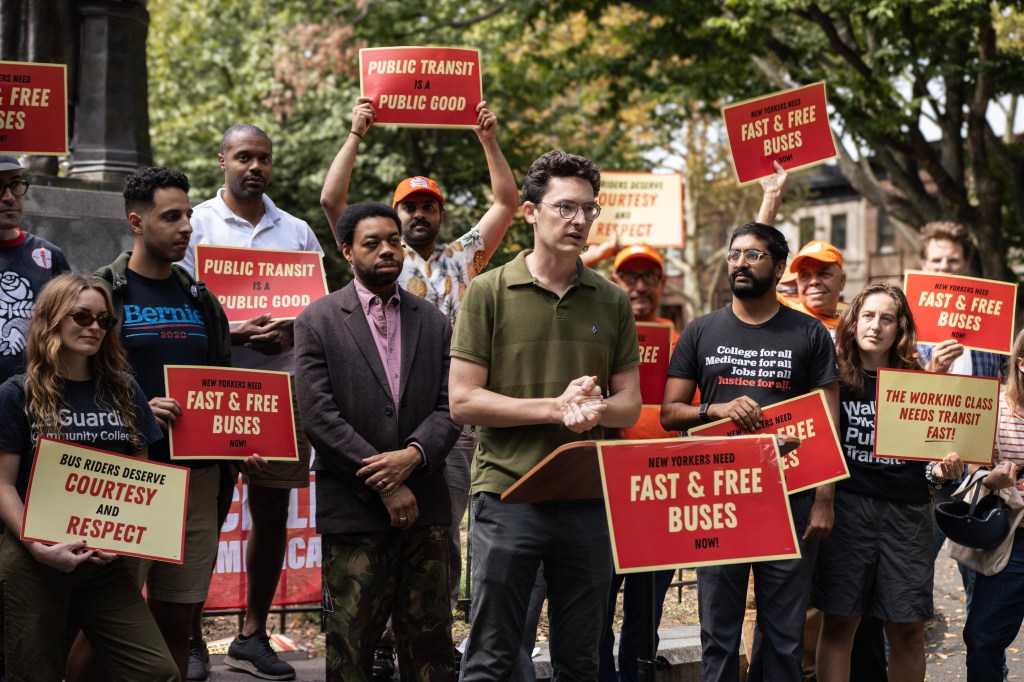
Now, the NYC chapter of the Democratic Socialists of America is trying to put the “free” back into the conversation. Its new Transit Working Group, co-chaired by Dheraj Ganjikunta and Alex Morano, kicked off a “Fast & Free Buses” organizing campaign this month, combining support for bus-priority projects with a longer-term push for fare-free service.
We spoke with Ganjikunta and Morano about why DSA is getting more deeply involved in transit, how they plan to organize bus riders, the local politics of bus lanes and how they think free buses could be paid for.
This interview has been edited for length and clarity.
Why did NYC-DSA create a transit working group now?
Dheraj: I think it was chartered because, in a way, transit is like a really important issue and the winning issue on the campaign trail from Mamdani, but there wasn’t at the time a structure to do that work, like transit-related work in the DSA, so it was definitely catalyzed by fast and free, and we all felt like we needed to organize strongly for fast and free buses.
Alex: It’s a space DSA has been absent from in past years, and so fast and free aside, we felt it was important for us to do more transit organizing.
Dheraj: Yeah, I think that there’s a lot of great NGOs and orgs in the space doing work there, and I think the DSA might not have seen it as like super deep of a need before to organize in that space, but I think the fact that transit is really the linchpin of affordability in New York City, and that that message so heavily resonated on the campaign trail, made it clear that in terms of making core services affordable for everyone and excellent for everyone, transit was really an excellent place to start.

Alex: And just to be clear, the chapter has done transit organizing in the past. We ran a Fix the MTA campaign and the ecosocialist working group has touched on other transit issues, so it’s not like we have been completely missing in action on transit. But having a working group dedicated to it makes it easier for us to plug our members into the issues and different organizing opportunities.
What are your policy goals for 2027, and what are you doing now to get there?
Alex: Right now, we’re really focused on organizing in response to the bus action plan along bus priority corridors, and we’re working to get bus riders organized and build their political power so that when we have the right opportunities to fight for free buses, whether it comes from taxing the rich or another revenue source, there’s already an organized base of bus riders who can plug into that opportunity and help ultimately make fast and free buses a reality.
Dheraj: Yeah, and I think even though the plan is out there for fast, not all 50 of those projects are fully funded, and clearly have funding for full scope. So I think we’re focusing on these super tactical 50 projects and making sure that they’re at full scope and funded, and then really building the grassroots infrastructure to also make sure that free happens.
Who do you expect to oppose those projects?
Dheraj: Yeah, I think when it comes to the fast side, a lot of those opponents are going to be at the local level, or it’s going to be project-specific opposition to projects, right? I think at the broad level, everyone wants fast buses across New York City, but when it comes to, like, turning streets into express bus lanes and taking up space to create bus shelters and other things like that, you’re going to see, like, potentially community boards, which are heavily stacked by people who ride cars.
Frankly, even though most New Yorkers don’t ride cars for their daily transit, these community boards are stacked with folks. And then there’s also lots of local community orgs and business orgs who might, for their own reasons, be opposed to specific projects, and so I think those are places where people working-class New Yorkers who do heavily rely on the bus, like nurses and teachers, we need to kind of activate those folks to show up at those community board meetings, at those project planning meetings, where often it’s these special interests who are like loudest in the room and batter down these projects.
Alex: Yeah. So Dheraj is right. I think broadly, everyone will tell you they want better transit. They want transit to be accessible, affordable for everybody. But then we still do see a lot of project-based opposition. We see that with bus lane projects already. As the scope becomes more ambitious, there are going to be more folks who come out of the woodwork to oppose these projects.
One of the things that this connects to is how bus riders are involved in the conversation related to improvements, and even if there aren’t opponents on a specific project, we still want to organize bus riders because right now the process for making changes to the street, making improvements to the bus system, really disenfranchises the people who ride the bus, and it tends to favor folks who have time to show up to a community board meeting. It tends to favor business interests, but this is a million New Yorkers we’re talking about every day who ride the bus, and they need to have more of a say in what happens with the bus system, and they need to be empowered to ask for improvements to the transit that they rely on.
How do you balance the push for free buses with the MTA’s need for funding?
Dheraj: Yeah, and I think when it comes to the free side of this, I think ultimately we want to have both like an excellent and efficient and an affordable transit system, and I think that means that folks may always push back on like, hey, instead of making the system affordable, we should fund X project or fund Y project, and we’re not saying that we should, the MTA is chronically underfunded, right? It needs cash for critical projects, but at a certain point, meeting the moment and meeting the need for affordability in New York also means using funding for getting the free side of fast and free buses, right?
Alex: It’s important that we have a well-funded transit system that prioritizes a lot of the operational things that Janno Lieber is focused on, like signal upgrades. That’s super important. And as socialists, we always want to put forward good policy without idealizing in a way that is going to compromise efficacy.
It’s also important that riders can afford to use the service, and fares are a burden for a lot of bus riders. We’ve been canvassing the past two months in Central Brooklyn, in Harlem, in Flatbush, and a lot of people don’t like that the bus fare is $3. They feel like it’s too expensive for the kind of service that they get, and so it’s an interesting political question.
But I do want to be clear where we stand on the policy side, right? We don’t want to put the MTA in any kind of fiscal trouble. We don’t want to jeopardize other important things about the transit system that a lot of the leadership, the MTA really values. Janno has said before, if you can find a way to pay for it, great. We’ll see how the political conversation changes in the next months and in the lead-up to the 2027 state budget.
What would you say to lawmakers outside New York City who question why the state should put more money into city transit?
Alex: Yeah, that’s a good question, and I think the discussions around what New York City gets versus what the rest of the state gets in the state budget are discussions that are to come and will be sorted out. Of course, it’s important to ensure that other folks throughout the state are given ample resources to meet the needs of the people who live there. We’re not just focused on giving things to New York and excluding the rest of the state.
Dheraj: Yeah, I don’t think it’s impossible that like many programs where the city pitches in to the MTA in order to support programs that support citizens of the city, like Fair Fares, it wouldn’t be like the city isn’t paying for at least parts of those programs themselves, too.
You mentioned parking as a possible source of revenue. What does that look like?
Dheraj: I think that, like, parking as a revenue raiser has been brought up before, and it’s not a crazy idea that out of the million-plus parking spaces that are basically subsidized by the city, some of them are charged for over and above what they are currently, right? Because basically we have free space for car owners at the cost to the city.
Alex: I don’t think there’s a specific implementation that we’re saying is the right way to go, but it’s certainly possible that generating revenue by changing how we charge for street parking is possible, and it’s something that could be part of the conversation around how different transit improvements or how fares are paid for.
Dheraj: Yeah, exactly. Like ultimately both fast and free would require probably under a billion dollars, right? So something like parking revenue projections have shown it could raise $2 billion, and even other revenue raisers that the city has or the state has proposed, right? Like they would also raise that money. None of these are set answers at all. It’s just like there’s definitely options, and it’s not like what we’re proposing with fast and free buses is completely outside of what is realistic. It’s very much possible with the budget as well.
What have you heard directly from bus riders so far?
Alex: I’ll just share a little bit of information about our event from over the weekend. We’ve been doing a lot of street and bus stop canvassing. We, for the first time as part of this work, were talking to New Yorkers at their door on Saturday. We knocked a few hundred doors in Bed-Stuy, Crown Heights, and this was along the B46 bus route. More than 65 percent of the folks we spoke to identified as regular bus riders, with the most common complaint by far being that the bus is too slow and they get stuck in traffic too much. The bus lanes get blocked.
So I think that’s just some useful information for you to think about knocking these doors. Really, a lot of people are saying that they’re regular bus riders. A lot of people rely on the bus, and these are the people we’re trying to empower and reach.

Read More:
Streetsblog has migrated to a new comment system. New commenters can register directly in the comments section of any article. Returning commenters: your previous comments and display name have been preserved, but you'll need to reclaim your account by clicking "Forgot your password?" on the sign-in form, entering your email, and following the verification link to set a new password — this is required because passwords could not be carried over during the migration. For questions, contact tips@streetsblog.org.