State DOT Yanks Safety From Long-Delayed Woodstock Tinker Street Project
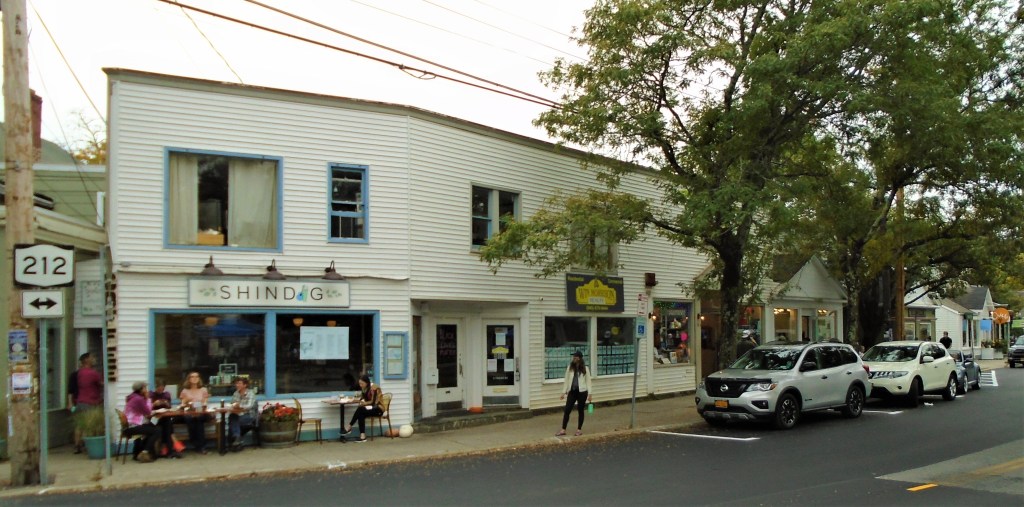
State DOT scrapped plans for lower speed limits and raised crosswalks from its plans to upgrade sidewalks on Woodstock’s popular Tinker Street, which it now says won’t wrap up until 2031 — and town officials say the agency has left them in the dark as to why.
Town officials touted DOT’s plans for a 25 mile per hour speed limit as recently as March, according to reporting from The Overlook. By August, the limit was out, along with raised crosswalks that were described as part of the project as recently as January, according to the co-chairs of the town’s Complete Streets Committee.
State DOT declined to answer detailed questions from Streetsblog. The agency has told town officials that raised crosswalks pose a potential challenge for snow plows, though the town believes they do not, and that a secretive study did not support a lower speed limit.
“We haven’t been able to see the study,” said Complete Streets Committee Co-Chair Grace Murphy said. “I do not think that the heads at DOT are as receptive to taking care of pedestrians as it is for taking care of motorists.”
A 2018 road safety assessment requested by the department’s regional office, meanwhile, found 69 crashes over five years on the segment of Route 212 that runs through the village, including four involving pedestrians and one bicyclist. The largest category involved parked vehicles. It also found that 15 percent of drivers west of Rock City Road exceeded 45 mph on a stretch posted at 30.
Locals had pushed for 10-foot wide car lanes, but state DOT insisted on 10.5 feet. None of the street’s existing sidewalks meet accessibility requirements, according to town leaders.
“Our sidewalks are a disaster right now,” said Howard Cohen, Murphy’s co-chair.
State law since 2011 requires the department to consider a “complete street” design on projects it undertakes, meaning a design that incorporates the needs of all road users. Bills pending in the state Senate and Assembly would go further and require it.
Reached for comment, state DOT declined to provide information about the safety study or the delay. A rep for the agency emphasized that the NYSDOT agreed to the town’s requests for upgraded sidewalks, crosswalks and curb extensions, and that the speed limit remained up for discussion.
The department told the committee in early October that it needs more time for engineering work before it can finalize the design, by December 2027, and collect bids from potential contractors starting in April 2028. Completion has now slipped to 2031. Murphy and Cohen said the department has not said what that work involves.
“The New York State Department of Transportation is engaging with local partners in the Woodstock area to ensure the Tinker Street project addresses the needs of the community to the fullest extent possible,” DOT spokesperson Heather Pillsworth said in a statement.
Under the schedule the committee outlined in August, crews would replace four aging bridges first and begin rebuilding the sidewalks about six months later, one side of the street at a time. The delay pushes the start of construction back a year, to November 2028, when crews would begin by removing 22 trees, and begin sidewalk work along with it.

Town officials wonder why the department can’t advance work on the street ahead of that timeline. Murphy said the committee does not know whether there is an engineering reason for the order of operations, or whether it is a department policy that should be reexamined.
In February 2022, then-Supervisor Bill McKenna told the Town Board the department was in preliminary design and that construction could start by spring 2024.
Facing pressure from the town complete street committee, state DOT agreed to curb extensions, improved curb cuts, five-foot sidewalks meeting accessibility standards and new crosswalks at side streets and Tannery Brook Road.
Some of the complexity is real, according to Kevin Smith, board chair of the Woodstock Land Conservancy. Kingston’s aqueduct and Woodstock’s water lines run along the road, and the bridges must be designed for heavier storms, Smith said.
However, the department has moved faster on highway work nearby. In 2022, Gov. Hochul announced the start of an environmental review to convert State Route 17 in Orange and Sullivan counties toward Interstate 86, backed by up to $1 billion. The project drew a litany of questions from residents, yet the department is widening a $68 million bridge on that corridor, expected to finish late 2026, even as it says review of the larger $1.3 billion project continues, as reported in January. That bridge is technically a separate project.
Locals are holding out hope that DOT eventually agrees to lower speed limits.
“We know statistically that it makes a marked difference in the likelihood of collisions, and if there are collisions, the severity of those collisions,” said Smith. “And even more so if the involved pedestrian or cyclist is a child or senior.”