ANALYSIS: MTA Example Case For Hochul’s Insurance Plan Does Not Hold Up To Scrutiny
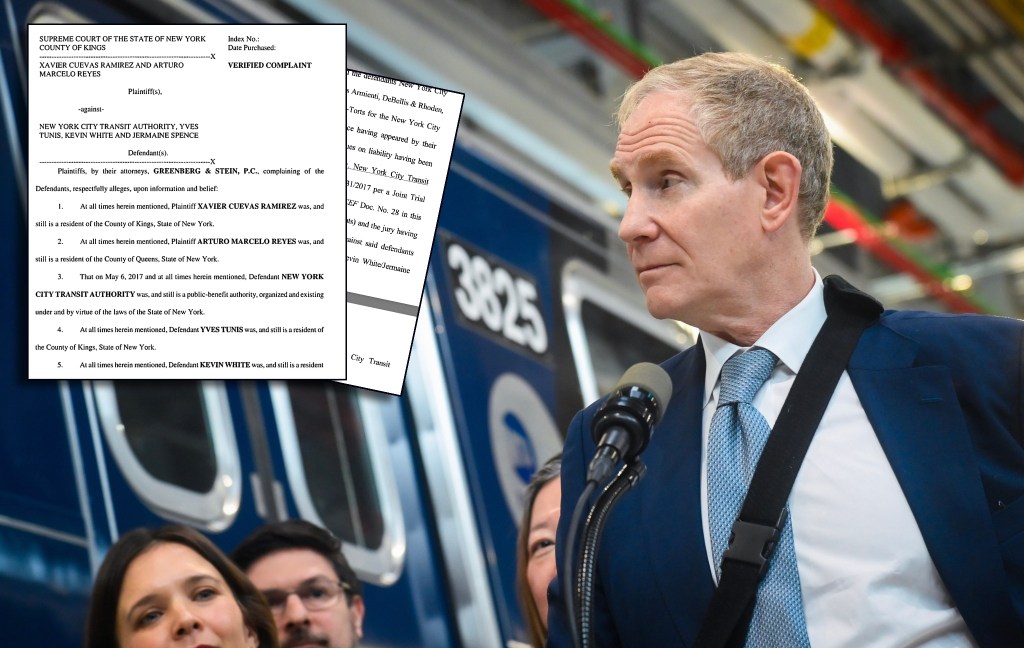
Xavier Cuevas Ramirez and Arturo Marcelo Reyes were walking on Avenue H in Brooklyn on May 6, 2017, when a driver speeding through a stop sign in a friend’s Acura clipped an MTA bus before slamming into the two pedestrians at E. 52nd Street, causing $4 million in permanent injuries and pain and suffering for which they have yet to be compensated.
The jury in Ramirez-Reyes v. New York City Transit Authority determined that the driver, Jermaine Spence, was 92 percent responsible for the crash, while the MTA was held 8 percent liable.
Spence, then 21, didn’t have the cash — nor the kind of insurance — to cover his $3.7-million share of liability, so under state law, the MTA will likely end up paying all of the damages.
The transit agency and Gov. Hochul have consistently used cases like these as the perfect example of why auto insurance needs to be reformed so that “billboard lawyers” can’t gouge the public for “jackpot payouts.”
The governor and the MTA are right that the case shows the need for reform — only not the reform that they want.
Lest we forget
Gov. Hochul contends that lawyers keep targeting the transit agency with frivolous lawsuits — but the effort to reduce the MTA’s own liability costs is actually a radical idea that runs counter to hundreds of years of common law as well as a crucial reform from the 1980s that set the stage for today’s battle.
At the time, laws held that in cases with multiple defendants, all of the responsible parties were, legally speaking, “jointly and severally liable” for making the victim whole with proper compensation for employment-related losses as well as non-employment losses (aka the very real, but often mocked, notion of pain and suffering).
The reason for that centuries-old reasoning is simple: the victims themselves can’t be left holding the bag when they’ve been wronged through no fault of their own.
But in the mid-1980s, the nation was in the midst of a liability insurance crisis felt deeply by small businesses, municipalities and medical professionals.
Lawmakers across the country were under pressure to bring down insurance prices by changing the way juries could award compensation
In New York State, the reform was overseen by a 1986 panel called the Jones Commission, created by former Gov. Mario Cuomo. No friend of the state’s powerful trial lawyers, Cuomo’s commission ended up altering insurance law so that parties in a multi-party suit that were less than 50 percent liable for an incident would not have to pay anything.
But — and it’s a huge but — motor vehicle crashes were intentionally exempted from that reform.
And there’s a simple reason for that, as we said above: the victims themselves can’t be left holding the bag when they’ve been wronged through no fault of their own.
Indeed, the Commission argued, that joint and several liability is essential in multi-party motor vehicle crashes because “a defendant’s insolvency should be borne by the other defendants, rather than by an innocent victim.”
In other words, someone has to compensate Xavier Ramirez and Arturo Reyes for the catastrophic injuries that altered the trajectory of their lives in 2017 and continue to cause suffering to this day — and it’s not going to be them.
It obviously should be Jermaine Spence, but the details of the case — it’s the ongoing 510505/2018 in Brooklyn Supreme Court, if you want to review it — show why it won’t be. Drivers in New York State are allowed to carry very little insurance — thanks to a legislature that does not want to increase the cost of driving. The state’s legal minimum covers just $25,000 in liability coverage per person and $50,000 per crash. That’s low, given how quickly a victim’s hospital bills will add up, but it’s especially cruel given that the minimum was last increased in 1996. In the 30 years since, inflation has reduced the value of that coverage from a paltry $25,000 to a criminally low $12,000.
Hangnail surgery costs more, let alone the multiple fractures, permanent loss of motion, and ongoing treatments that Ramirez and Reyes require, according to court papers.
The Department of Motor Vehicles declined to provide Streetsblog with the number of drivers who are currently operating their two-ton motor vehicles at high speeds with such low coverage, but it is a sizable number. Gov. Hochul and the legislature could require drivers to carry more insurance, but instead, she’s pushing a plan to make it harder for victims to get full compensation for their injuries and to limit the MTA’s financial exposure in crashes.
She also wants to change the system so that drivers who are found at least 51 percent responsible for a crash would get no compensation beyond no-fault, even if a jury finds that the other driver or victim, such as a cyclist who jumped a red light, shares a significant portion of blame.
Naturally, the MTA is eager to help. Since Gov. Hochul unveiled the sketch of the plan in her State of the State address, MTA CEO Janno Lieber has been telling anyone who will listen — including Streetsblog readers in an op-ed published today — the yarn that if MTA is found even just “1 percent responsible” for a multi-party crash, the agency ends up paying 100 percent of the jury’s award to a victim.
He testified as such at a Feb. 3 state budget hearing on transportation. He stood with the governor on March 13 and bemoaned frivolous lawsuits by “billboard lawyers” for driving up the MTA’s liability costs. He complained at a March 25 MTA board hearing that current laws let anyone dip into the MTA’s coffers no matter how little the MTA was involved in a crash.
And he told City & State on March 31 that the MTA is targeted by bad actors who know that they have deep pockets if they’re taken to court.
Except there’s one problem — well, two, actually: Xavier Cuevas Ramirez and Arturo Marcelo Reyes.
First, the obvious: The jury did not find the MTA 1 percent liable, but 8 percent because bus driver Yves Tunis did not follow rules by placing his foot over the brake when approaching the intersection (in fact, his foot was shown at trial to have been on the gas pedal).
Still, an 8-percent liability shouldn’t force the MTA to pay out nearly $4 million in damages, should it? No, if you agree with Lieber, who scoffs at the single-digit liability. But yes, if you follow the law.
That 8 percent may sound small, but before arriving at that single-digit number, the jury first ruled that the MTA was “substantially” responsible for the crash. Indeed, before sending her jury into deliberations, Justice Caroline Cohen specifically lectured the panel on how to determine the MTA’s liability.
“There may be more than one cause of an accident [sic], but to be ‘substantial,’ it can’t be slight or trivial,” Cohen said, according to court records. “You may, however, decide that a cause is ‘substantial’ even if you assign it a relatively small percentage to it.”
So even an 8-percent liability determination reveals the MTA’s “substantial” role in the crash, said Joanne Doroshow, the executive director of the Center For Justice & Democracy at New York Law School.
“That’s the way it works,” she told Streetsblog.
She has little sympathy for the MTA’s position.
“If one of the entities can’t pay the other, the substantially responsible party should pay because otherwise the victim has to pay,” Doroshow said. “That was the intent of state lawmakers and the elder Cuomo in the 1980s.”
And Ramirez and Reyes’s lawyer, Josh Stein, is offended by the MTA’s argument both in his case and in the larger effort to reform auto insurance premiums.
“Remember, when this reform passed in 1986, car crashes were made exempt, and there was a reason for that,” Stein told Streetsblog. “There were victims of car crashes that were getting left out in the cold, and the legislature decided to protect them. And the legislature could have carved out the Transit Authority or other agencies, but it didn’t want to do that.
“Besides,” he added, “the MTA has a greater responsibility. I mean, if you drive a 100,000-pound bus, you probably should be a little more careful than somebody who’s driving a car.” (He also pointed out that the MTA can sue Spence for his missing liability contribution by garnishing his wages, for example.)
Stein also called for the legislature to require drivers to have more coverage — as he, himself, carries. “I have way more insurance than I need because I don’t want to have to be personally responsible if I get into an accident [sic] with somebody who has less insurance than I do, or has nothing to protect.”
There are several efforts to require drivers to carry more insurance. Assembly Member Alicia Hyndman (D-Queens) has a bill (A2189) that would raise minimum coverage 10 fold, to $250,000 per person and $500,000 per accident. Also, state Sen. Leroy Comrie (D-Queens) and Hyndman have teamed up on legislation (A3106/S5235) that asks the state Department of Financial Services to study the effect of increasing minimums.
“We’ve been advocating for higher minimums for years,” Stein said, adding that Gov. Hochul’s main ally in her fight to change auto insurance rules doesn’t like higher minimums.
“Uber lobbies against this and other types of legislation that would force their drivers to be more financially responsible,” Stein said. “Certainly, the MTA and other governmental entities would benefit from a raise in the insurance minimum. Instead, drivers with the minimum end up with less coverage over time.”
Meanwhile, Reinvent Albany Executive Director John Kaehny isn’t sure why the MTA doesn’t explore other legislative remedies rather than throwing in its lot with a proposal that would do serious damage to New Yorkers.
And like a lot of the governor’s proposal, the lack of information backing up its claims is jarring.
“We, the public, do not know exactly what’s going on with the MTA and other government agencies, which may be getting really soaked under the current system, and they are us, because we ultimately pay the bills,” Kaehny said. “And that’s a problem, because it makes it hard to have an informed opinion about exactly what the right policy should be here.”


Read More:
Streetsblog has migrated to a new comment system. New commenters can register directly in the comments section of any article. Returning commenters: your previous comments and display name have been preserved, but you'll need to reclaim your account by clicking "Forgot your password?" on the sign-in form, entering your email, and following the verification link to set a new password — this is required because passwords could not be carried over during the migration. For questions, contact tips@streetsblog.org.