Hochul Signs Insurance Bill That Guts Crash Victims’ Rights
ALBANY — Everybody wins — except the victims.
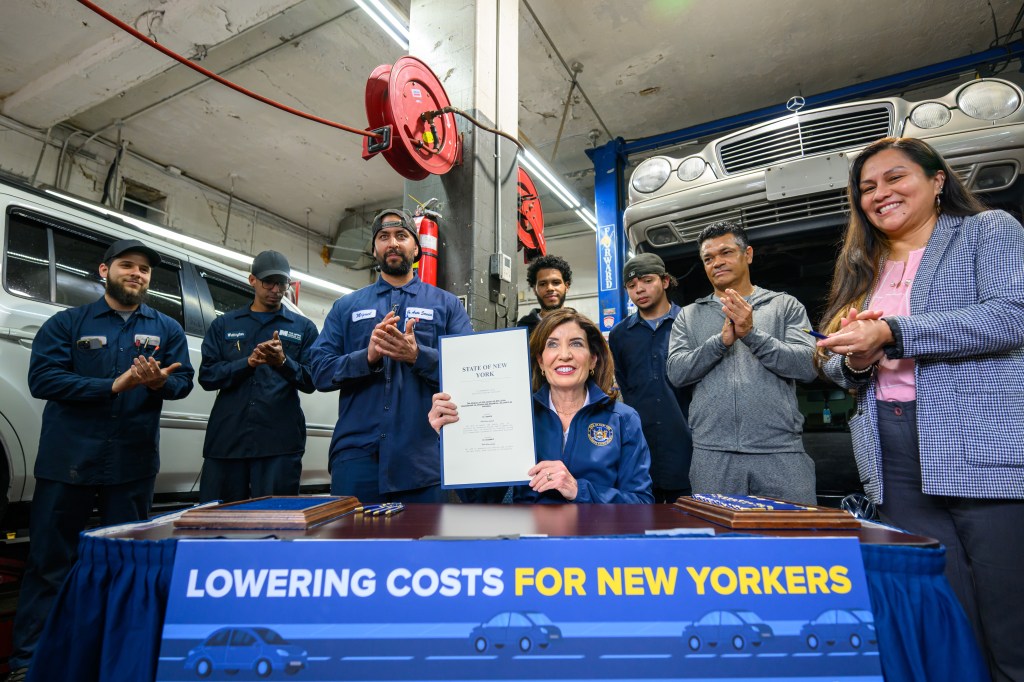
Gov. Hochul hailed the passage of her auto insurance reform as part of this year’s state budget at a bill-signing ceremony on Wednesday in New York City, a place where people are far more likely to victims of cars rather than their owners.
The governor said her reforms would save residents of the state money, but of course, she was talking only of drivers, as the Big Tech-funded push to lower insurance rates was partly built on reducing compensation to victims of car crashes — not that the governor mentioned them.
“My view is when our reforms kick in, hardworking New Yorkers will be the beneficiaries; they’ll have lower insurance bills, instead of the insurance executives taking home bigger profits,” Hochul said at the ceremony at an uptown body shop.
Hochul held the line during budget negotiations against some lawmakers who objected to provisions that strip crash victims of some of their legal rights and rejected Hochul’s pitch that rampant fraud and runaway lawsuits are causing New York’s supposedly high auto insurance rates. In the end, she got just about everything she wanted.
The key provisions remain as they were towards the end of the budget dance: The budget narrows the definition of serious injury by removing victims who are unable to resume daily activities for 90 of the 180 days following a crash. That change matters because a serious injury lets New Yorkers receive compensation for pain and suffering, and many who suffer traumatic brain injuries or soft tissue injuries find themselves falling into this category rather than those describing an injury to an organ.
Crash victims (pedestrians and drivers) who are found 51 percent or more responsible for a crash will get no compensation.
Payouts for pain and suffering will be capped at $100,000 for uninsured motorists, which could be someone borrowing a car. This lumps them in with drunk drivers and motorists in the process of committing a felony.
The only main area where the governor “lost” was on her attempt to change a state law that requires parties involved in a crash to fully compensate victims — which is called “joint and several liability,” because all parties are jointly responsible. But sometimes, drivers who are less than 50 percent responsible for a crash end up paying more than 50 percent if the other driver doesn’t have any money or enough insurance coverage — the idea being that victims can’t be left holding the bag.
Rather than require drivers to carry more insurance, the governor wanted to eliminate “joint and several,” which could leave some victims under-compensated. Lawmakers managed to remove this part of the proposal during negotiations.
They also added new requirements and regulations for insurers, such as barring them from using consumer data like occupation status or profession, education level obtained, homeownership status or ZIP code when setting premiums. The practice of ‘flex rates,” or automatic premium increases up to 5 percent by insurers, is over. Companies have to explain these increases to the state Department of Financial Services each time.
Insurance companies stood to benefit the most, but Uber invested more than $8 million in a messaging campaign to help sell Hochul’s assertion that fraud and exorbitant payouts were driving rising prices. Meanwhile, the association of state trial lawyers was vastly outspent, funneling about $120,000 a month on lobbying firms to counteract the Big Tech push.
“Uber and Big Insurance waged the most expensive legislative attack in New York history, attempting to strip key protections through a budget deal that bypassed the normal legislative process and public scrutiny,” Sabrina Rezzy, a spokesperson for the New York State Trial Lawyers Association, said in a statement.
Uber’s spending was actually part of a nationwide attempt to push tort reform and ultimately lower its liability as a company. In many states, including New York, it finds itself responsible for crashes it’s drivers get into, and many victims that Streetsblog spoke to were themselves drivers for ride share companies or injured inside of them.
The fraud narrative was mostly put to bed by Streetsblog after we pointed out that there was a dearth of documented cases of auto insurance fraud in New York, and so few of the allegations led to arrests or were even implicated in the insurance law that Hochul wanted to reform. And if affordability was such a concern, as the governor repeatedly stated, then perhaps she should not have given the industry a 22-percent increase in 2024.
The long fight over insurance was a primary reason that this was the latest budget of Gov. Hochul’s tenure. When all is said and done, state lawmakers will have just days to focus on non-budget legislation.

Read More:
Streetsblog has migrated to a new comment system. New commenters can register directly in the comments section of any article. Returning commenters: your previous comments and display name have been preserved, but you'll need to reclaim your account by clicking "Forgot your password?" on the sign-in form, entering your email, and following the verification link to set a new password — this is required because passwords could not be carried over during the migration. For questions, contact tips@streetsblog.org.