KOMANOFF: Mayors Have a Congestion Pricing Ace Card — Here’s How to Play It

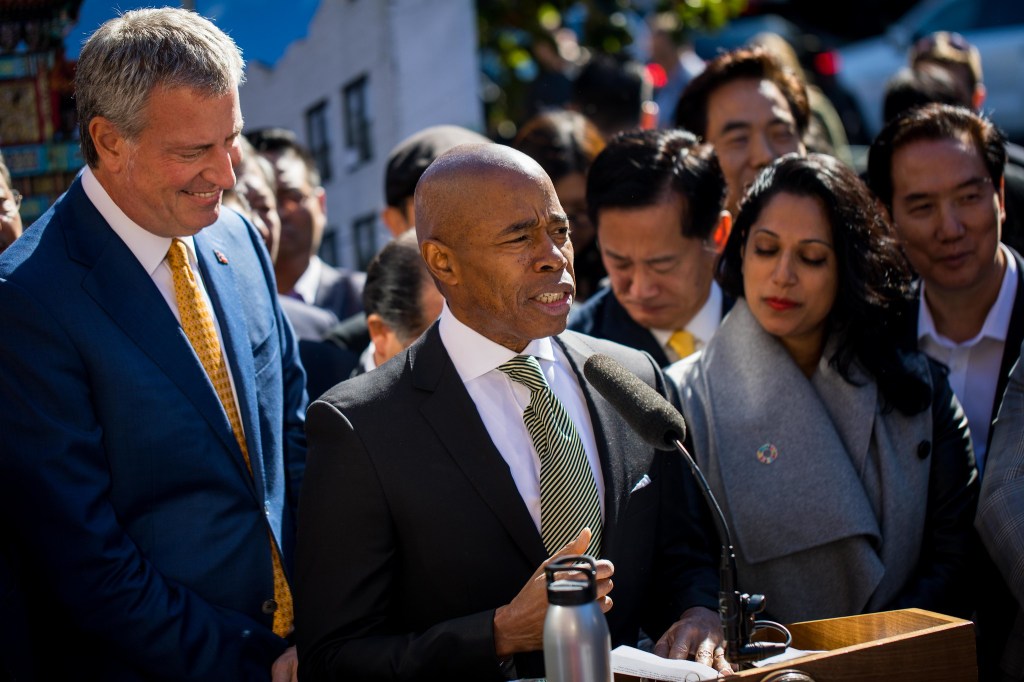
Two guys from Brooklyn walk into a bar. Congestion pricing, now, they order.
Will they get it?
They should, seeing as how they’re our current and next mayors.
Our story began during last Thursday’s monsoon. Democratic primary victor and presumptive next mayor Eric Adams saw the now-iconic footage of a commuter wading into the 157th Street #1 station amid waist-deep stormwater, and, on Twitter, demanded “congestion pricing $ ASAP to protect stations from street flooding.”
“This cannot be New York,” Adams vowed.
Fast forward to Tuesday. In his daily press briefing, Mayor de Blasio caught the Adams alley-oop and threw it down.
“I want to see congestion pricing start as quickly as humanly possible.” he announced. The mayor had obviously supported congestion pricing before, but his timing earned him coverage in the New York Post.
“I think it’d be tremendously helpful at this point — reducing congestion,” the mayor added. “We need to get people back into mass transit and we need the support for mass transit.”
So what, you ask? The legislature passed congestion pricing in 2019 because the state, not the city, has the authority to enact it, right? And the legislation directed the MTA to design and operate the central business district tolls, right? The city can just shut up and wait, right?
Except that nothing in the 2019 statute, NY Vehicle & Traffic Law Article 44-C §1701-06 (read it here), bars New York City from implementing congestion pricing first. Moreover, contrary to received wisdom, the city has had authority to toll its roads and bridges since 1957. That’s when the legislature augmented New York’s V&T Law with §1642(a)(4), explicitly permitting cities with over a million residents (i.e., New York City) to impose “tolls, taxes, [and] fees … for the use of the highway or any of its parts where the imposition thereof is authorized by law.”
We wrote two posts about 1642(a)(4) in 2017: Move NY Campaign Says Toll Reform Can Bypass Albany — Is City Hall Listening? in June, followed in July by Top Legal Expert Concludes NYC Has Power to Toll Its Own Roads and Bridges.
That “top legal expert” was Frederick A.O. Schwarz, Jr., who was the city’s corporation counsel (i.e., director of the city’s law department) from 1982 to 1986 and later chairman of the City’s Charter Revision Commission and of its Campaign Finance Board.
As we noted then, Schwarz’s support for “home-rule tolling,” expressed in an op-ed in Crain’s New York written jointly with law professors Roderick Hills, Jr. (NYU Law faculty) and Eric Lane (Hofstra Law School dean), lent powerful weight to the idea that Mayor de Blasio could overhaul New York’s dysfunctional toll regime with nothing more than a majority vote by the City Council.
All that was mooted the following month, when Gov. Cuomo, in an August, 2017 front-page New York Times story, pronounced congestion pricing “an idea whose time has come.” Nineteen months, one blue-ribbon panel and a progressives takeover of the state Senate later, the governor’s toll bill sailed through the legislature. The tolls would start in early 2021.
Except they didn’t, of course. The holdup was COVID, then it was the Trump administration’s refusal to “scope” the congestion pricing environmental review. That excuse should have started winding down on March 30, when U.S. Transportation Secretary Pete Buttigieg notified the MTA that a streamlined “environmental assessment” would suffice. Write “fewer cars = fewer emissions,” mix with “more funding = better transit = even fewer cars,” stir in a few air quality modeling results at the toll boundaries, and you’re done.
Instead, the EA has vanished in the bureaucratic maw, with no timetable, no progress reports, nada — save for MTA spox Ken Lovett’s telling the Post yesterday, “We are early into that [“environmental assessment] process.”
Nothing speaks slow-walking like “early into the process,” except perhaps MTA Chief Financial Officer Bob Foran blurting to the authority’s board last month, “We’re not in a position now to really be needing, absolutely, at this point in time, the congestion pricing proceeds for the capital program.”
Poof. It’s hard to interpret Foran’s remark, along with Lovett’s and the thick curtain shrouding the EA, as anything other than a ploy by Cuomo to keep congestion pricing out of next year’s gubernatorial race. (Also up in smoke? The MTA’s 40-year dictum to never turn down offered funds.)
Here’s how the possibility of home-rule congestion pricing can help. Our two mayors can brandish it as a cudgel to force the governor to put the MTA’s environmental assessent on a fast and public timetable. It’s a credible threat, after all, one that says, “If you don’t want congestion pricing, or want it soon enough and bad enough, fine. We do. And we can get it.”
“We’re starting our own EA,” Adams and de Blasio can tell Cuomo. “We ask you to promise to wrap the MTA’s by X date. If you won’t, we’ll pass our own bill and get our toll plan up and running — as fast as humanly possible.
“The legislation you passed in Albany was a fine start,” the two can say. “It’ll be our point of departure. But home rule gives NYC the money and lets us control the shots.”
Now, bartender, how about those drinks?

Charles Komanoff is a national expert on congestion pricing and traffic modeling, and is the former head of Transportation Alternatives. He is a longtime Streetsblog contributor. Reach him at komanoff@gmail.com.
Read More:
Streetsblog has migrated to a new comment system. New commenters can register directly in the comments section of any article. Returning commenters: your previous comments and display name have been preserved, but you'll need to reclaim your account by clicking "Forgot your password?" on the sign-in form, entering your email, and following the verification link to set a new password — this is required because passwords could not be carried over during the migration. For questions, contact tips@streetsblog.org.