Move NY Campaign Says Toll Reform Can Bypass Albany — Is City Hall Listening?

Move NY takes its congestion-charge campaign to City Hall today, with testimony contending that New York City has legal authority to toll its own roads and bridges. The group will also outline a “home rule” version of its toll-reform plan that the City Council and the mayor can enact through legislation without approval from the state legislature or the governor.
The Move NY testimony, to be submitted at a council transportation committee hearing, in effect refutes a half-century of received wisdom holding that congestion pricing for New York City must be navigated through Albany. It is the product of meticulous legal scholarship by Roderick (Rick) Hills Jr., the William T. Comfort III professor of law at NYU Law School, tracing the origins of an overlooked 1957 amendment to the state vehicle and traffic law, VTL Section 1642(a)(4), which provides that cities with over a million residents (i.e., New York City) may impose “tolls, taxes, [and] fees … for the use of the highway or any of its parts where the imposition thereof is authorized by law.”
Professor Hills will be joined by Move NY campaign director Alex Matthiessen, who will outline an abbreviated version of the group’s ambitious toll-reform plan. The “home rule” version unveiled today employs at-speed digital tolling to charge autos $2.75 — the price of a subway or bus ride — to enter and leave the Manhattan Central Business District, i.e., $5.50 for a round-trip. Multi-axle trucks pay higher rates but they and other commercial vehicles are charged for no more than one round-trip per day.
Matthiessen will explain that in lieu of the entry and exit fee, for-hire vehicles (yellow and green cabs and app-based services such as Uber and Lyft) will pay per miles and minutes driven within the “taxi exclusion zone” south of 110th Street (on the West Side) and 96th Street (East Side). These FHV surcharges are designed to counteract rising congestion that was ascribed to rapidly growing use of Uber vehicles in a recent major report by transportation consultant (and former NYC DOT senior official) Bruce Schaller. The FHV surcharges also ensure that the biggest share of the congestion charges falls on residents of Manhattan, unlike the 2007-08 Bloomberg toll plan that would have raised the most revenues from residents of Queens and Brooklyn.
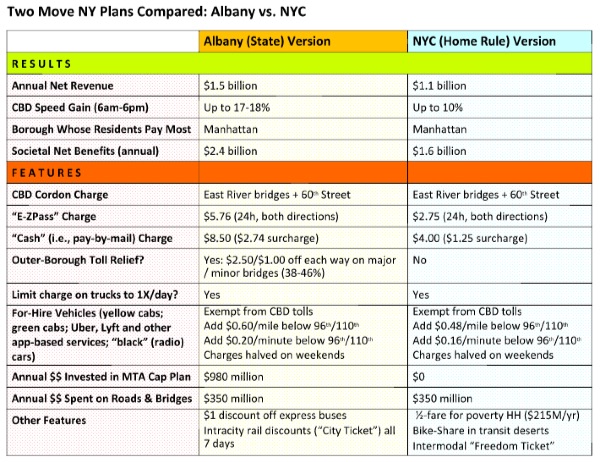
According to Matthiessen, this home-rule Move NY plan could speed car and truck travel in the Manhattan core by up to 10 percent and also raise at least a billion dollars a year for road and transit improvements. Atop that list could be the Riders Alliance’s proposed “fair fare” to make subway and bus travel affordable for low-income households, at an estimated cost of $215 million a year — a proposal that enjoys majority support in the City Council. The home rule plan’s revenues could also fund more buses, bus-priority lanes, further buildout of Citi Bike and more diligent bridge maintenance.
The “full” Move NY plan has languished in the state legislature. It envisions a higher CBD entry and exit toll, $5.76 in each direction, matching the current toll on the MTA tunnels and major bridges. The higher toll revenue and dedication of revenues to the MTA — which can only be done through state legislation — would enable the authority to lower tolls on its four major bridges by $2.50 in each direction, and on its three minor bridges by $1 each way. The 38-46 percent toll reductions — called a “toll swap” by the plan’s progenitor, former NYC traffic commissioner and renowned transportation planner-engineer “Gridlock” Sam Schwartz — would not be possible under the slimmed-down city version of the plan.
Note: Charles Komanoff’s “Balanced Transportation Analyzer” showing the inputs and outputs of the city version of the Move NY plan may be downloaded here. Komanoff is not formally associated with the Move NY campaign.

Charles Komanoff is a national expert on congestion pricing and traffic modeling, and is the former head of Transportation Alternatives. He is a longtime Streetsblog contributor. Reach him at komanoff@gmail.com.
Read More:
Streetsblog has migrated to a new comment system. New commenters can register directly in the comments section of any article. Returning commenters: your previous comments and display name have been preserved, but you'll need to reclaim your account by clicking "Forgot your password?" on the sign-in form, entering your email, and following the verification link to set a new password — this is required because passwords could not be carried over during the migration. For questions, contact tips@streetsblog.org.