Not So Fast: Advocates Aren’t Sold on Gov. Hochul’s AV Push
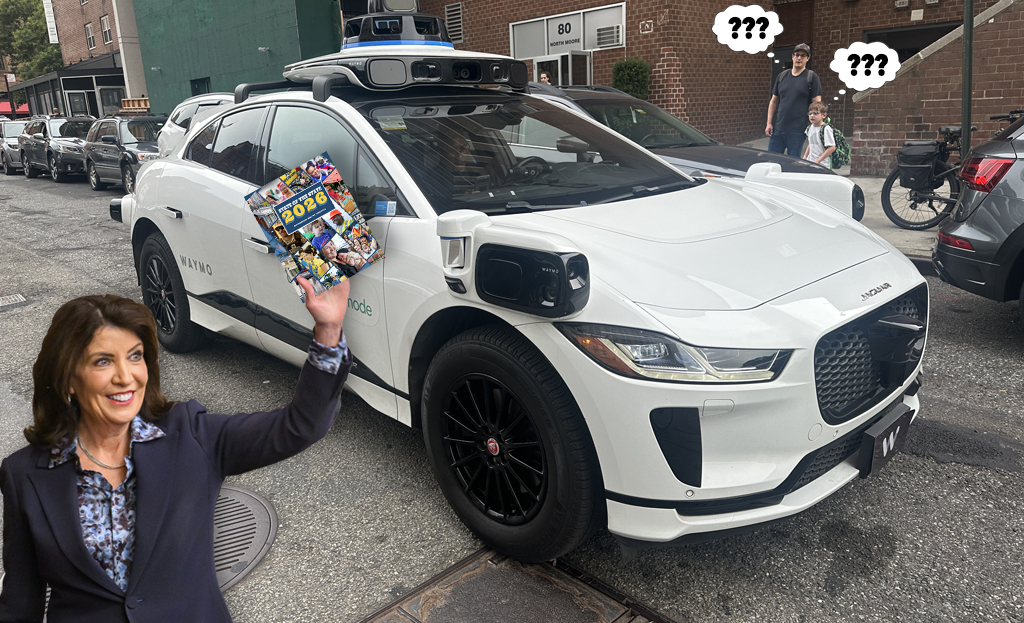
Not so fast on robo-cars, governor.
Livable streets advocates and one of the leading lawmakers in the push for safe streets slammed Gov. Hochul for announcing in her annual “State of the State” address that she wants to foster the “deployment of commercial for-hire autonomous passenger vehicles outside New York City.”
Open Plans, the city-based livable streets group, said in a statement issued even before the governor started speaking that it “has serious concerns.”
“Any program to allow fully driverless, for-hire autonomous vehicles, like Waymo, to operate in cities other than New York City must be met with serious scrutiny,” the group said, even before the full text of any proposed legislation was revealed. “There is no evidence that autonomous vehicles help us achieve our goals to make our state or city’s streets more people-centered.”
The group said it was pleased that the governor had exempted New York City, but added that “there are still too many unanswered questions to allow fully driverless AVs anywhere in New York State.”
And Assembly Member Emily Gallagher told Streetsblog, flatly, “I don’t think we should have Waymo in New York City or in New York.”
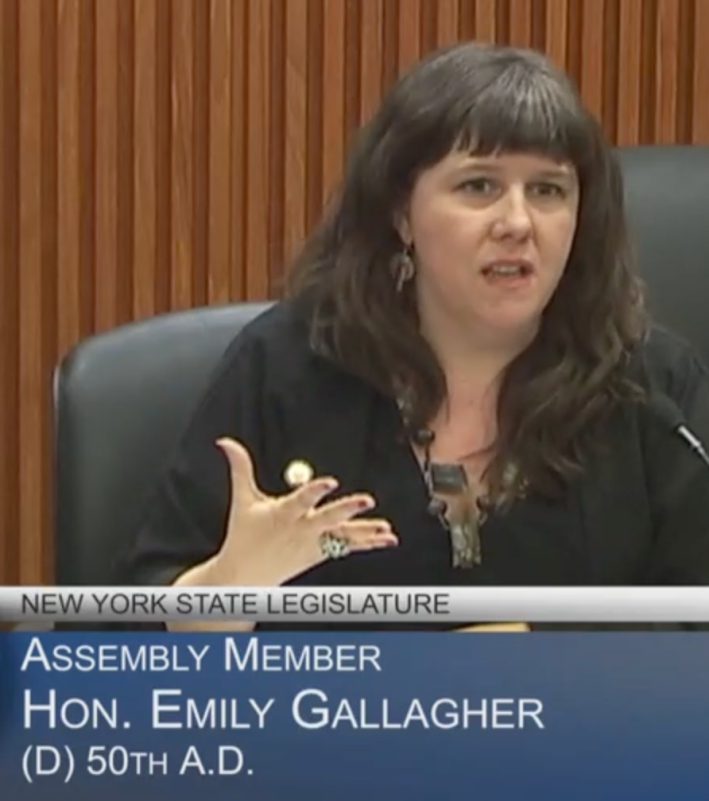
“It’s really important that human beings are operating cars and that those cars have speed limiters in them,” she said, referencing a bill sponsored by herself and state Sen. Andrew Gounardes that would require the installation of a speed-control device inside the cars of the worst drivers (the bill failed last session). “You cannot ask a robot to do a human’s job. There’s a lot of perception and sensory things that we need to do when we’re driving that, you know, I’m not trusting Waymo to do at this point.”
The AV industry claims that robo-cars are safer — computer-driven cars don’t get drunk or fall asleep at the wheel, for example — but it’s not possible to verify this fully because AV companies withhold data for objective analysis.
That could explain why Gov. Hochul’s proposal, which was revealed on Tuesday morning in her 164-page “State of the State” policy book, was a bit cagey about her plans.
“Autonomous vehicle technology is advancing quickly, and New York has an opportunity to act to ensure its safe and responsible use on our roads,” the book states. “AV companies interested in piloting services that expand and improve mobility options for communities will be required to submit applications that demonstrate local support for AV deployment and adherence to the highest possible safety standards.
“This initiative builds on years of successful testing demonstrations across the state and reflects growing evidence that autonomous vehicles can improve road safety and transportation options when introduced thoughtfully,” she concluded, though it is unclear what “successful testing” she is referring to.
The reason? New York State has been something of a leader … in keeping AV technologies out of the state. According to Wired, the Empire State “has some of the tightest laws governing autonomous vehicles, requiring companies approved to test in the state to only do so with a driver behind the wheel. There’s no current path for companies to operate the sort of commercial robotaxi services like the sort seen in San Francisco or Las Vegas.”
Waymo is currently testing eight vehicles in the city, under a permit from the city Department of Transportation. None of those vehicles can pick up a passenger (yet), nor be in motion without a driver at the wheel in the event of disaster.
Wired also reported that Waymo has spent hundreds of thousands of dollars to lobby state officials.
Common sense suggests that computer-controlled vehicles will be safer than human-piloted vehicles simply because computers don’t make as many mistakes as humans, in addition to remaining sober and alert at all times.
But this common sense obscures some serious problems with AVs, advocates say. For one thing, it’s not fully clear if AVs are safer, as Streetsblog has reported.
“Any testing in New York State must give government, academics, and advocates full access to gather and analyze safety and performance data – something that has been insufficient in other rollouts across the country,” continued the statement from Open Plans (which shares a parent company with Streetsblog).
Regulations such as those are exactly what car companies don’t love.
“The auto industry and tech industry don’t like regulations,” Cathy Chase, the president of Advocates for Highway and Auto Safety, told Streetsblog in 2024. “They like to be given carte blanche to put out whatever products they want. And historically speaking, regulations were the way that we’ve achieved higher levels of safety.”
Next, privately owned self-driving cars could dramatically increase vehicle miles traveled because a car owner could have his vehicle chauffeur him to work, then return home by itself before making the return round-trip when the factory whistle blows, as Streetsblog has reported. All that excess driving will make streets less livable and certainly less inviting, even if there are fewer crashes.
There’s also the damage that self-driving cars will do to millions of workers in the taxi industry, which is a key part of reducing car ownership in cities, or whether the AVs will reduce public transit use.
“While framed as limited in scope, the proposal would normalize the commercial use of unproven technology on public roads and set a precedent that could be used to justify expansion into denser, more complex environments,” a coalition of taxi driver and limousine service providers said in a statement.
“This is not about geography. It is about trajectory,” added Ira Goldstein, executive director of the coalition, called the Black Car Fund. “Authorizing driverless for-hire vehicles anywhere in New York sends a clear signal that the state is willing to put experimental technology on public roads at the direct expense of working drivers and the jobs they rely on. Once that happens, expansion is not hypothetical. It is inevitable.”
New York Communities for Change echoed the labor issue, but also broadened the fight against untested technologies.
“New Yorkers have seen this playbook before. Companies pilot risky technologies in less-populated areas, normalize them politically, and then
pressure regulators to open the floodgates in dense urban communities, regardless of public opposition or worker harm,” the group said in a statement.
One of the statehouse’s biggest boosters of autonomous vehicles was excited that Gov. Hochul had boosted the effort.
“Look, this technology is here. It’s growing very quickly, and not just the West Coast, but also in East Coast cities like Philadelphia, and Jersey and Miami and Washington, so to have New York not participate is just not where we are as a state of innovation,” said state Sen. Jeremy Cooney (D-Rochester).
And he brushed aside safety concerns. “There’s reason to believe they [AV companies] have done their due diligence,” he said.
“Look, we’re going to do testing, reauthorization,” he said before steering again to the innovation part of the question. “If we learn from what happened with ride-sharing back, what 15 years ago, when that first launched in New York City only, and the upstate didn’t get to opt in, right? People were coming from New York City up to places like Rochester and saying, ‘What the heck? I can’t get an Uber?’ [Without Hochul’s AV proposal], people from Los Angeles, or, you know, Philadelphia, or Rochester, are going to say, ‘Why can’t I get a Waymo in New York City?'”
Meanwhile, other strategies for safe streets always work, such as reducing car use rather than changing and expanding it. Congestion pricing in New York City, unveiled just one year ago, has successfully reduced car use in the central business district and residents can already see the improvement that comes from fewer cars on the street.
“We are on the path towards a city where the streets are for people, not just cars,” Open Plans said. “Bringing automated vehicles onto our streets only drives us further away from a safer, more humane, and equitable New York.”
In addition, regulators have the power — right now — to alter existing cars in ways that would reduce hundreds of thousands of crashes and injuries every year.
“I do see the benefits of autonomous vehicle technology and making things safer, but I also would say, ‘Why don’t we just adopt those things into our everyday vehicles now?'” Bruce Appleyard, a city planning professor at San Diego State University once told Streetsblog USA, referring to “speed governors to slow cars down and early-detection warnings and that make them better able to detect pedestrians and bicyclists.”


Read More:
Streetsblog has migrated to a new comment system. New commenters can register directly in the comments section of any article. Returning commenters: your previous comments and display name have been preserved, but you'll need to reclaim your account by clicking "Forgot your password?" on the sign-in form, entering your email, and following the verification link to set a new password — this is required because passwords could not be carried over during the migration. For questions, contact tips@streetsblog.org.