Hochul’s Car Insurance Plan Blows Fraud Way Out Of Proportion: Stats
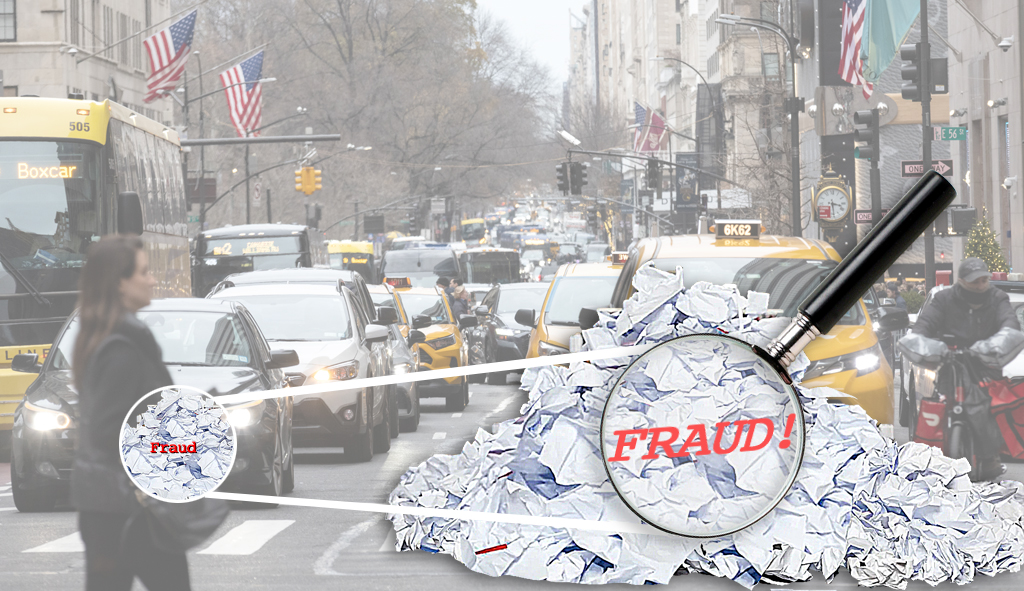
There’s less than meets the eye.
Gov. Hochul’s Big Tech-backed push to lower auto insurance premiums has rested on her assertion that rampant insurance fraud is driving up rates, but the number of fraud investigations, arrests and convictions is laughably small, a Streetsblog investigation has found.
District attorneys in and around New York City have prosecuted only a handful of drivers for staged crashes, including DAs in counties where insurance costs are among the highest in the state — a finding that undermines Hochul’s argument that fraud is leading to what she calls New York’s “high” insurance costs.
Beyond vague comments about allegedly rampant staged crashes, Hochul and her Department of Financial Services have claimed that regulators received 43,811 reports of “suspected motor vehicle insurance fraud” from insurers in 2025 — a term that can mean fraudulent no-fault insurance claims, theft, arson, larceny from motor vehicles, vandalism, collision damage, falsified invoices and fraudulent insurance cards.
The agency said 70 percent of the “suspected” fraud cases were related to no-fault insurance — an important footnote because Hochul’s proposed reforms make no change to the state’s no-fault insurance, which provides $50,000 in coverage for people involved in crashes, no matter who is at fault.
Of the 43,811 allegations of fraud lodged by multi-billion-insurance companies, the state opened just 243 investigations and made 169 arrests. A spokesperson for the agency declined to say how many convictions state authorities notched — but even if every single arrest resulted in a conviction, the state’s closure rate on insurance fraud is less than 0.4 percent.
There’s a reason for the yawning gap between reports of alleged fraud and a conviction. Experts told Streetsblog that insurers can be quick to allege fraud to avoid making payouts. And since a huge part of insurance companies’ profits come from holding onto income for as long as possible for the purpose of reinvesting it, these companies have an incentive to cry fraud and hold onto that cash.
In 2024, the Department of Financial Services’s Insurance Frauds Bureau only opened 316 cases for investigation out of all 52,105 reported insurance and financial fraud, according to its most recent annual reporting. Those cases resulted in 227 arrests and 145 convictions — a closure rate of 0.27 percent.
You would be hard pressed to find any New Yorker who thinks any level of fraud is “good,” but the data refutes the idea that there is an epidemic of fraud in the state, and that these incidents are to blame for what Hochul believes are high insurance costs for consumers. Fraud may be a factor, but as state Sen. Jamaal Bailey (D-Bronx) put it, the issue “isn’t binary.”
“If we find no evidence of fraud, then fraud can’t be the major cost driver that they’re saying it is,” he said. “Also, then maybe portions of the [premiums] which they have indicated are due to fraud, maybe those should come down.”
Staged crashes?
Gov. Hochul has zeroed in on staged crashes in particular as a root cause of high insurance rates, but she has not substantiated the connection between the two. The Department of Financial Services has claimed there were 1,729 staged crashes in the state in 2023, according to a recent agency press release, but officials declined to clarify how many of those led to convictions. In any event, those allegedly staged crashes represent a tiny fraction of the 381,290 reported crashes that year, according to the Department of Motor Vehicles.
State legislators in 2019 passed a law that established the specific felony crime of staging a car crash, but local district attorneys revealed that not only are staged crashes rare, they’re barely on the law enforcement radar.
The NYPD’s Fraudulent Collision Investigation Squad made only 23 arrests for staged collision in the second degree in 2023, but the number of convictions is even lower, according to a police spokesperson who did not provide a name
A borough-by-borough look reveals that few if any cases ever made it to court.
Brooklyn District Attorney Eric Gonzalez’s office was “not aware” of the NYPD making any arrests for staged car crashes in recent years, according to spokesperson Oren Yaniv.
Yet Kings County has some of the highest auto insurance costs in the state, according to the financial products research website Bankrate.
Similarly, Manhattan District Attorney Alvin Bragg did not have any prosecutions on record since “at least 2018,” said spokesperson Emily Tuttle.
Bronx District Attorney Darcel Clark secured convictions in just four cases last year, according to spokesperson Patrice O’Shaughnessy — though two of those cases ended in guilty pleas to disorderly conduct, not insurance fraud (a fifth case is pending). The rep acknowledged that they “do not get many cases” of staged crashes.
There have been some high-profile instances, such as the viral dashcam footage that followed a 2024 crash on the Belt Parkway that quickly made headlines and led to Queens DA Melinda Katz charging two men with staging three crashes. Those defendants are still on trial, according to a spokesperson for Katz’s office, which has just six total staged crash cases since 2020.
The office of Staten Island District Attorney Michael McMahon did not respond to Streetsblog’s request for information about insurance fraud prosecutions.
The district attorneys of both Nassau and Suffolk counties had zero prosecutions for staged crashes.
Taken together, it is clear that prosecutors in two car-dependent suburban counties, plus those in four New York City boroughs with high insurance costs, say they aren’t fielding auto insurance fraud cases. That explains why lawmakers, victims and other critics of Hochul’s proposal have been voicing two concerns: one, that the governor is exaggerating the fraud problem, and two, that she wrongly believes that fraud is driving up insurance costs.
“It wasn’t clear on the first day, and it’s not clear today, and it won’t be clear in a month from now, six months from now, or a year from now, because there’s no correlation,” said Andrew Finkelstein, president of the New York State Trial Lawyers Association, which has been the most prominent opponent of Hochul’s reforms.
Finklestein supports combatting fraud, but said its scale is being overblown by the Hochul administration.
Meanwhile, the Hochul Administration disputed Streetsblog’s findings from Nassau and Suffolk counties; a spokesperson said that the Department of Financial Services got reports of 8,216 cases of “suspected auto insurance fraud” on Long Island in 2025, and has 27 active insurance investigations in that region.
“The idea that insurance fraud somehow does not occur on Long Island is outrageous,” said Hochul spokesperson Sean Butler. “The only people seeking to minimize the problems of insurance fraud and staged accidents are the fraudsters themselves and the special interests who get rich off of these schemes, all while New Yorkers who play by the rules suffer.”
But Butler confirmed that the state agency refers its cases to those very same District Attorney’s offices. If those law enforcement officials decline to prosecute, it speaks for itself.
Insurance companies have also launched lawsuits independently of prosecutors, said Chuck Bell, a programs director at Consumer Reports, a non-partisan consumer advocacy organization. Those can involve multiple forms of fraud beyond staged crashes, like medical mills, inflated claims, and RICO cases.
A big business grift
Hochul is simply repeating insurance industry talking points to distract from her efforts to erode crash victims’ rights to sue for damages – which are unlikely to bring down costs anyway, experts have said.
“Whenever anybody looks into it, it’s a phony argument, it never is the kind of fraud they’re talking about, it doesn’t exist,” said Joanne Doroshow, the executive director of Center for Justice and Democracy and co-founder of Americans for Insurance Reform. “They believe that if the public buys into the notion that fraud exists … it’s easier for them to turn the tide against everyday people who try to file claims.”
Insurance companies make profits by investing the money from premiums until they have to pay it back out in claims, also known as insurance “float.” Berkshire Hathaway Chairman Warren Buffett once described float as “money that we hold that doesn’t belong to us.”
Hochul has claimed that combatting fraud would cut insurance premiums by $300, citing estimates by the Insurance Information Institute, a trade group for the insurance industry.
The Citizens Budget Commission, which supports Hochul’s proposals, was more conservative in its forecast, saying that New York drivers might save $200 a year, based on recent, but different, insurance reforms in Michigan and Florida.
However, insurance companies themselves have been hesitant to make any promises.
According to State Farm, the largest auto insurance provider in the nation by market share, premiums rise and fall based on underlying costs like vehicle repairs, litigation, inflation, fraud and abuse, and the idea premiums will be lowered for the foreseeable future is tough to grasp.
“Whether auto insurance gets more, or less, affordable in the years ahead is impacted by whether the underlying costs of claims go up or down,” the company said in a statement.
Hochul has proposed taking a look at the state’s excess profits regulations, which are supposed to divert insurance revenues back to policyholders. She has released few details about that plan, and it’s unlikely to yield savings, since insurance companies currently claim to operate at a loss in New York State, and could simply argue that they don’t have any profits to redistribute, according to Doroshow.
“They would come back with an argument saying, ‘We’re not making any money here, so policyholders don’t get to get any of our money,’” she said. “The governor will never hold them accountable.”
Hollowing out rights
The governor argues that prices will go down if the state chips away at the rights of crash victims to sue for damages. That includes narrowing the state’s definition of “serious injury,” which entitles victims to seek damages for pain and suffering beyond the $50,000 covered by no-fault insurance. Currently, the term “serious injury” includes injuries like fractures, permanent loss of an organ or member, loss of a fetus, or a medically determined non-permanent injury that keeps one out of work for more than 90 days.
Hochul wants to disqualify people in that last category, even if the injuries keep victims from going through their day-to-day lives for three months. This would have a dramatic effect on crash victims with traumatic brain injuries or soft tissue injuries because they don’t neatly fit the remaining definitions.
Currently, in trials, juries apportion blame for a crash in percentages, and each party receives compensation for pain and suffering that corresponds to their share of responsibility. The governor also wants to change that system so that drivers who are found at least 51 percent responsible for a crash would get no compensation beyond no-fault — even if a jury finds that the other driver or victim, such as a cyclist who jumped a red light, shares a significant portion of blame.
Hochul also proposed limiting pain and suffering damages for drivers who are uninsured at the time of a crash. This applies not only to people who intentionally drive without insurance, but also anyone borrowing a car from someone else and without coverage in place.
Those are all efforts known as tort reform, which aims to reduce people’s rights to sue for damages. Doroshow, who has fought tort reform for decades, including with lawyer and consumer rights activist Ralph Nader, said those measures don’t actually work, especially given how opaque insurance companies are around justifying their rate increases.
“It’s a fantasy to think that that’s what’s going to bring rates down, particularly in a state like this that has weak regulations,” she said.
The governor’s plan pairs these changes in coverage with legislation that would make it easier for district attorneys in New York to target individual actors and organized rings committing car insurance fraud, like staged crashes. This part of the proposal has broad-based appeal.
The state Senate and Assembly omitted Hochul’s insurance proposal from their one-house budgets, which are a rebuttal to the governor’s executive budget proposal. The exclusion could signal a lack of consensus among state lawmakers or a legislative chasm between the state Legislature and the governor.
Editor’s note: No one has been covering Gov. Hochul’s insurance reform proposal with the diligence of Streetsblog. Since Hochul announced her plan in January, Streetsblog NYC’s Kevin Duggan and Streetsblog Empire State’s Austin C. Jefferson have joined forces to publish nearly two dozen deeply reported pieces on the plan. They are all archived here.


Streetsblog has migrated to a new comment system. New commenters can register directly in the comments section of any article. Returning commenters: your previous comments and display name have been preserved, but you'll need to reclaim your account by clicking "Forgot your password?" on the sign-in form, entering your email, and following the verification link to set a new password — this is required because passwords could not be carried over during the migration. For questions, contact tips@streetsblog.org.