Lawmakers Question Hochul’s Insurance Claims In Leadup To Budget Rebuttal
ALBANY — State lawmakers aren’t sold on the idea that fraud and jackpot lawsuits are to blame for New York’s allegedly high insurance rates, raising serious questions about how Gov. Hochul’s bid to reduce premiums will affect crash victims.
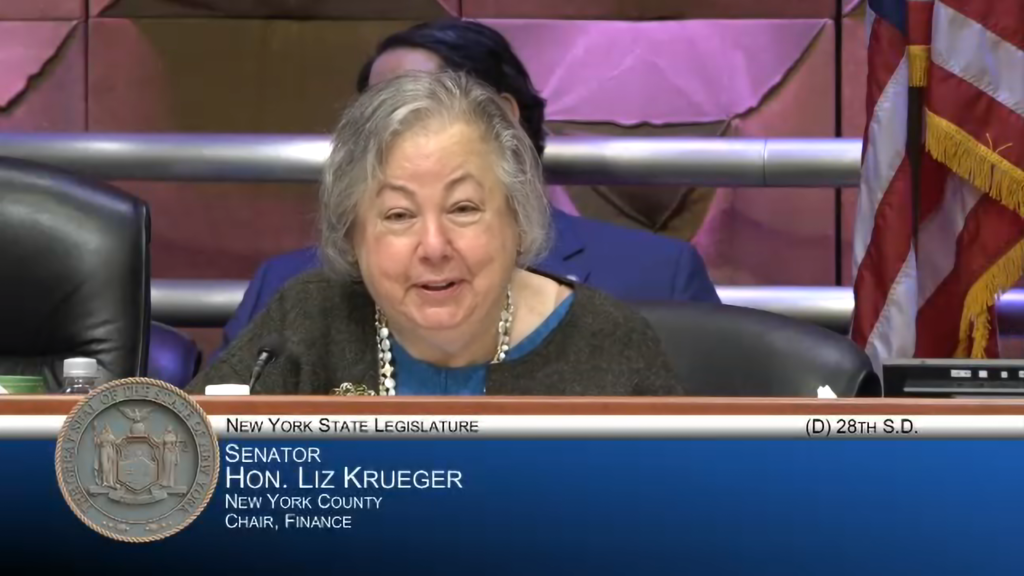
At a state budget hearing on Thursday, Senate Finance Chair Liz Krueger (D-Manhattan) had the strongest words about Hochul’s vaguely sketched-out plan, which might end up reducing some crash victims’ compensation for injuries and suffering.
“I don’t think there is anyone in the legislature or anyone in the state of New York who doesn’t want us to go after insurance fraud,” Krueger said. “But we also don’t want people’s civil rights to be taken away from them through the court system when something bad happens.”
She added her own experience as an insurance customer makes her question the role fraud plays in insurance pricing, given that her car insurance rates have risen steadily over 35 years even though she has never made a claim.
“When you also talk about insurance fraud … how many of us have been advised [to not file a claim] if it’s not that big a claim … because our rates will go up,” she said — suggesting that what’s really going on is the opposite of fraud.
Gov. Hochul has made reducing auto insurance premiums a marquee issue in her executive budget proposal. She blames fraud and large payouts as the driver of high rates, and proposed increased penalties for auto insurance fraud, like staged crashes, and stripping away protections for crash victims via a mix of capped payouts, reduced coverage and reduced liability as solutions. But the administration has not provided numbers to back up its allegations. At one point, the governor’s office issued a press release claiming fewer than 2,000 “staged’ crashes had occurred — in a state with close to 400,000 crashes per year.
The Hochul administration also faced questioning from Senate Insurance Committee Chair Jamaal Bailey (D-Bronx) and his Assembly counterpart David Weprin (D-Queens), both of whom tried to get their heads around the idea that somehow crash victims wouldn’t be losing rights in Hochul’s plan.
Here’s why there are concerns: Currently, the legal definition of serious injury is one that is so catastrophic that crash victims can additional compensation. The current definition includes death, loss of a fetus, dismemberment, permanent loss of use of a body organ, member, function or system, fractures, significant disfigurement, permanent consequential limitation of use of a body organ or member and medically determined non-permanent injuries that keeps a victim out of work for more than 90 days.
Hochul wants to disqualify people in that latter category of non-permanent injuries, even if the injuries keep victims from going through their day-to-day for three months.
The law’s current language ensures that injuries that don’t fit the definitions eyed by Hochul but are debilitating physically and financially, like a concussion or spinal injury, still qualify victims to pursue necessary compensation as they rebuild their lives.
Weprin asked Acting Department of Financial Services Superintendent Kaitlin Asrow if Hochul’s change would mean victims with traumatic brain injuries and soft tissue injuries, both currently covered, are unable to seek additional compensation following a crash. She erroneously claimed nothing would change.
“It maintains eight clinical definitions of serious injury that someone can get care for … the functioning of major organs remains in the serious injury definition,” Asrow told lawmakers. “And so something like a traumatic brain injury would, of course, be an impact to the brain organ. So we believe that would still be covered.”
Asrow’s logic contradicts the governor’s claim of using objective determinations to identify serious injuries. In the course of seeking compensation or a settlement, a crash victim would need to demonstrate that the effects of their injuries were “consequential” and “significant.” That is objectively more opaque than counting how many days of work someone missed.
Bailey later asked a panel of insurance industry trade groups at a hearing yesterday if they would actually commit to lowering auto insurance rates in New York and ask their affiliates to do the same, not just in the immediate aftermath of the proposed legislation passing, but for the foreseeable future.
There wasn’t time to answer, but he requested they send a response by March 5, as the state Legislature begins to finalize its budget rebuttals and negotiations with the governor begin in earnest.
He also wondered how we got here.
“Where did these proposals come from,” he asked. “Was it drafted by the good folks on the second floor?”
Well, sort of; as Streetsblog previously reported, when Streetsblog asked for information on Hochul’s proposal, the governor’s office forwarded a fact sheet produced by an Uber-backed advocacy group called Citizens For Affordable Rates.

Read More:
Streetsblog has migrated to a new comment system. New commenters can register directly in the comments section of any article. Returning commenters: your previous comments and display name have been preserved, but you'll need to reclaim your account by clicking "Forgot your password?" on the sign-in form, entering your email, and following the verification link to set a new password — this is required because passwords could not be carried over during the migration. For questions, contact tips@streetsblog.org.