Sohn in Albany: State Bill to Force Drivers to Pass Safely Stalls

ALBANY — So safer streets are great for New York State, but not for New York City?
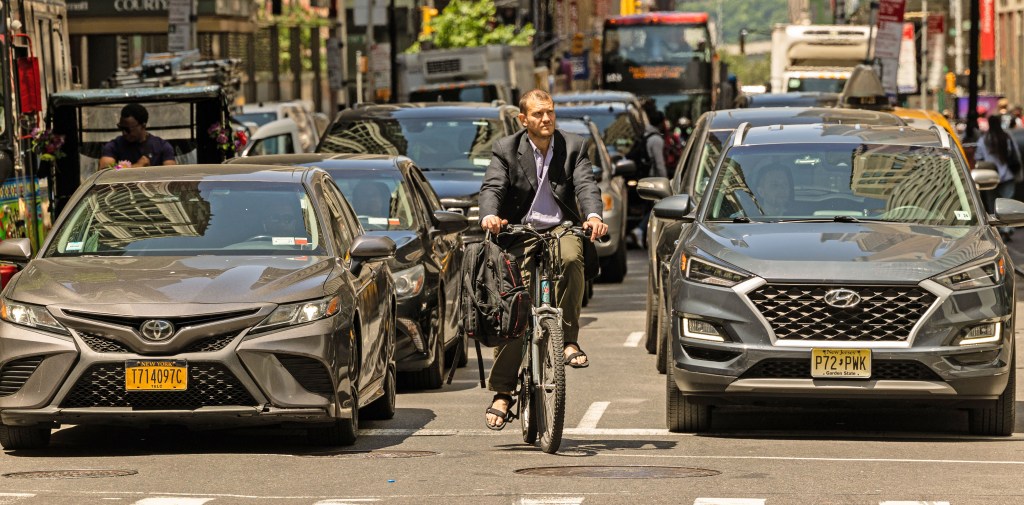
That’s the only conclusion one could draw from last week’s Senate overwhelming approval of the so-called Defined Safe Passing bill, which requires drivers to maintain at least three feet of distance when passing pedestrians, cyclists, and people who use wheelchairs and other mobility devices everywhere in New York State except in the five boroughs of New York City, where road violence is a public health epidemic.
So what’s up with that? Apparently New York City is just too unsafe for such safety legislation, or in Albany-ese, “New York City’s population-dense environment creates a number of unique challenges to implementation,” the bill’s memo states.
That means that even if Defined Safe Passing gets through the legislature this session, the law in the city will remain that a driver must pass “at a safe distance,” whatever that means.
The bill’s Assembly sponsor Phil Steck (D-Albany) told Streetsblog that some lawmakers “felt that [the three-foot passing distance] couldn’t be followed in New York City because of the road structures being different, the setup of the roads and so forth.”
The Senate sponsor, Pete Harckham (D-Westchester) agreed that “streets and roadways [in the city] are not wide enough to accommodate a three-foot buffer zone between motorists and bicyclists. Also, the many intersections in the city and heavy pedestrian traffic on its crosswalks make the idea of consistent room for a buffer zone less realistic.”
Is New York City really that different from the 40 states (including all of those that border New York State) that have defined safe passing laws? Is New York City that different from Washington, D.C. (or Monroe and Suffolk counties) which have such a law?
Of course not, especially when the purpose is not urban planning but safety.
The purpose of the laws is to leave less discretion to drivers … and juries in the event of a crash. If the “safe distance” is undefined, “the driver or a jury gets to interpret what that means,” said Ken McLeod, policy director of the League of American Bicyclists. “They may not have the same feeling about what’s safe as someone on a bike does.”
A set “safe distance,” he added, “is an empirically provable thing. A bicyclist can prove it was less than three feet.”
It’s not odd that New York State is such an outlier, given this bill’s tortured history through the Capitol.
When Steck first introduced the bill in 2016, there was no carveout for New York City (no biggie, because the bill died anyway). Former Assembly Transportation Committee Chairman David Gantt would not move the bill. Steck said Gantt believed “it would only give the police additional excuses to ticket or arrest African American motorists.”
The late Gantt, a Rochester Democrat, had a poor record on safety issues, as Streetsblog previously reported.
The city Department of Transportation has long admitted something needs to be done, given that drivers kill, on average, a dozen cyclists per year. But the city said in 2017 that it would “explore legislation requiring vehicles to provide three feet … when passing.”
Nearly a decade after that statement, the city has taken no action.
When Steck and Harckham reintroduced their bill in 2021, there was suddenly a carveout for cities with populations over one million people — which is Albany-speak for New York City. Other states with such legislation, even California, do not carve out their main cities — presumably because those are exactly the places where safe passing is so crucial.
The bill isn’t expected to pass the legislature this session because it’s not on the Assembly’s legislative priority list (which was drawn up before the left hand in the Assembly knew what the right hand in the Senate was doing).
For its part, the city DOT basically said “don’t blame us” for the legislature’s failure to pass the bill.
“DOT supports clearer passing requirements for New York City,” a spokesperson said when asked if DOT had lobbied against the bill.
For now, Steck is focusing on the next session.
“We could debate it as a policy matter,” he said. “But as a practical matter, we have to get the bill past the Assembly bureaucracy, which is called Program and Counsel, and if they don’t want the bill in New York City, Phil Steck saying that the bill should apply in New York City is not going to help get it passed. We need to try to do the best we can with the cards that we are dealt.”
Then he quoted sociologist Max Weber’s definition of the stubbornness of bureaucracy.

Read More:
Streetsblog has migrated to a new comment system. New commenters can register directly in the comments section of any article. Returning commenters: your previous comments and display name have been preserved, but you'll need to reclaim your account by clicking "Forgot your password?" on the sign-in form, entering your email, and following the verification link to set a new password — this is required because passwords could not be carried over during the migration. For questions, contact tips@streetsblog.org.