Gov. Hochul’s West Side Highway Safety Plan Is 12 Months Late (And Counting)
The notoriously intractable state Department of Transportation is slow-walking its plan to address urgent safety concerns along Manhattan’s treacherous West Side Highway — and is now 12 months and counting behind the 18-month timeline it announced for its study back in 2024.
State DOT’s current timeline wouldn’t see the study released until the end of March 2027 — 17 months behind schedule and a full three years after it announced the study. Advocates and elected officials have clamored for years for safety improvements along the corridor, which has not substantially altered in decades.
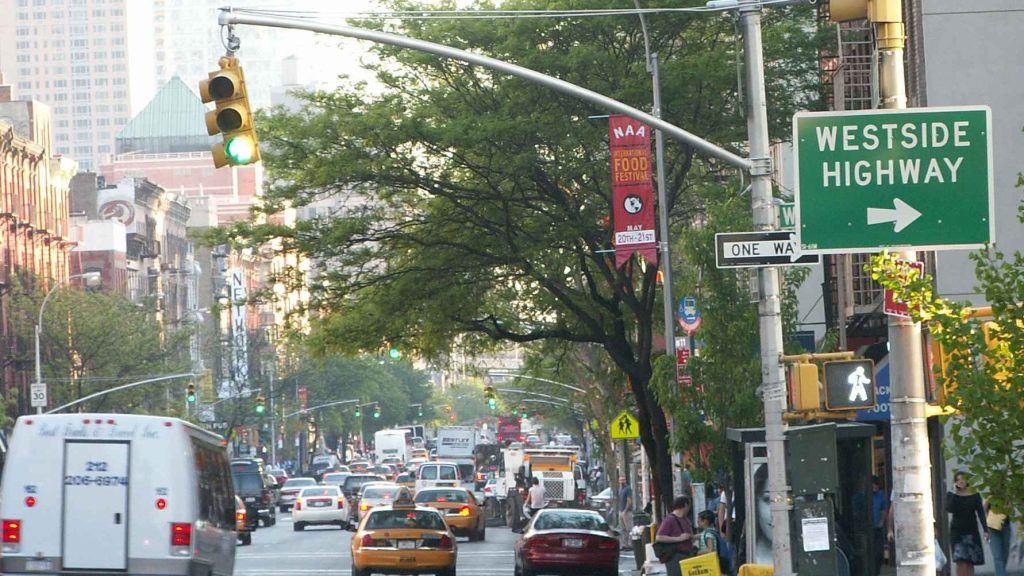
Once home to the elevated “West Side Highway,” State Route 9A continues to carry that name, at least unofficially — and in spirit: Despite running alongside the busiest greenway path in the country, the road effectively functions as a six-lane highway with traffic lights.
That extreme width forces pedestrians and cyclists to put their lives at risk to access the Manhattan waterfront. The greenway itself has not been substantially altered in decades, even as its popularity has grown. Local officials have pressed for a redesign for years.
Despite that urgency, officials are still reviewing feedback collected at public meetings it held way back 2025, state DOT told Streetsblog — an odd excuse given the agency’s historic willingness to push through controversial highway projects in the fact of sizable opposition.
“To ensure that the full breadth of public feedback can be incorporated, NYSDOT will issue concept recommendations for the future of mobility along this critical corridor by the end of Q1 2027,” agency rep Rolando Infante told Streetsblog last month.
DOT spokesman Glenn Blain told Streetsblog in March 2024 that identifying “existing needs and potential enhancements” along Route 9A — West Street and 12th Avenue between the Battery and West 59th Street — would take “approximately 18 months.” That mark passed in September of last year, though DOT’s webpage for the study says the it actually began in September 2024.
Infante said DOT received “strong community feedback” from its public engagement, which consisted of all of three in-person meetings.
NYSDOT declined to share how many comments it had received in total, but its publicly available tally pales in comparison to the amount of feedback it’s received for highway projects that took far less time to materialized.
In public documents, DOT officials have variously said that either 95 or 150 people attended the three meetings held in spring 2025, raising more than 150 concerns, 65 potential cross-section designs and 46 suggested intersection safety evaluations.
That may sound like a lot, but it pales in comparison to the amount of feedback state DOT received on highway projects it ultimately fast-tracked in spite of significant opposition.
On Route 17 in Orange and Sullivan counties, for example, which NYS DOT is about to widen despite shrinking traffic levels, state DOT received over 225 written comments. But the study only took 29 months — less than the 36-month expected study period on Route 9A.
Closer to home, the agency shoved through an effort to build new highway off-ramps in the pollution-saturated neighborhood of Hunts Point while completely ignoring community pleas for it to explore alternatives.
Just last week, road safety advocates from across the five boroughs called out state DOT for its sluggish approach to addressing urgency safety needs.
“State DOT still does not do strong safety-driven projects as a matter of course, and when they have a mandate to deliver strong bike/ped design, it takes them longer than it should,” said Parks & Trails New York Executive Director Paul Steely White. “These are precisely the kinds of improvements that should be fast tracked. There’s really no excuse for this delay in my in my view.”
Manhattan Borough President Brad Hoylman-Sigal, a key proponent of a West Side Highway safety revamp, said state DOT gave him the same reason for the delay as it gave Streetsblog, and that he takes the agency at its word.
“They told me that it’s about the unexpected volume of input they’ve received,” he said. “I take them at their word, that that’s legitimate.”
Still, safety on the corridor remains “an ongoing area of concern,” Hoylman-Sigal said.
From the time work on the study got underway in September 2024 until June 15, 2026, the most recent available data, some 495 recorded traffic crashes occurred within the study area, according to city records — leading to 236 injuries and one death.
Of those injured, 37 were on foot and 37 were on bikes — many if not all of them trying to access the Hudson River greenway and other waterfront amenities.

In 2022, then-Manhattan Borough President Mark Levine proposed that state DOT put a protected bike lane in the streets westernmost car lane to take pressure off the greenway, which serves pedestrians as well as cyclists.
“Tens of thousands of people cross the West Side Highway daily,” Jeffrey LeFrancois, executive director of the Meatpacking District Business Improvement District, said at the May 2025 workshop. “Route 9A is disproportionately allocated to cars, and it needs to be fixed.”

Read More:
Streetsblog has migrated to a new comment system. New commenters can register directly in the comments section of any article. Returning commenters: your previous comments and display name have been preserved, but you'll need to reclaim your account by clicking "Forgot your password?" on the sign-in form, entering your email, and following the verification link to set a new password — this is required because passwords could not be carried over during the migration. For questions, contact tips@streetsblog.org.