New York Jurisdictions Target the Wrong ‘E-Bikes’ as Market Outpaces State Law
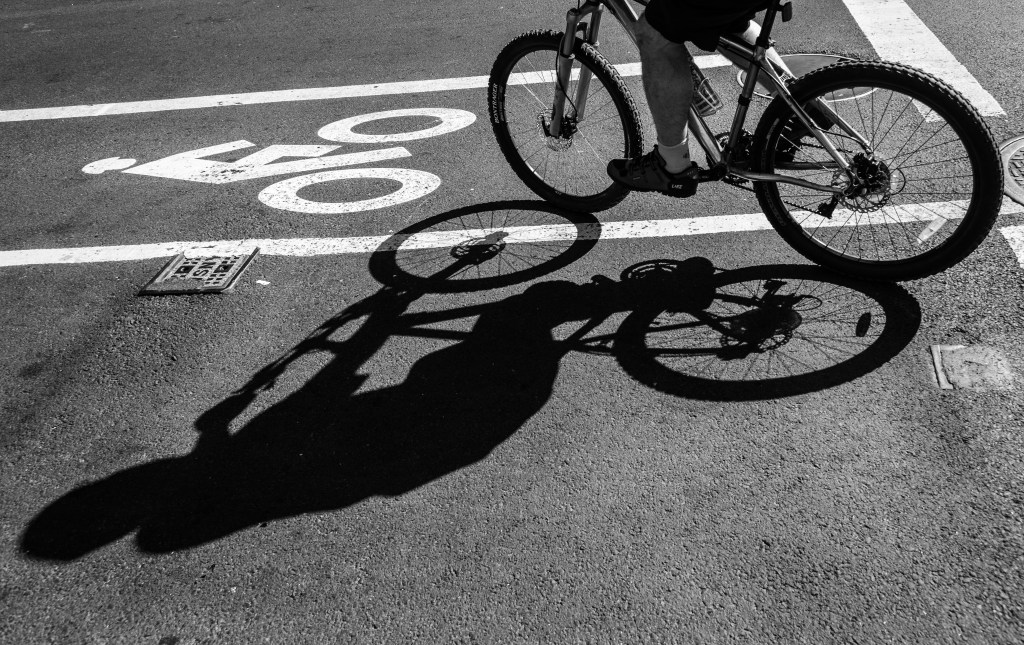
Lawmakers across the Empire State have instituted a hodgepodge of restrictions that lump e-bikes in with concerns about unsafe, illegal e-motos — targeting law-abiding riders in response to panic about the contraband two-wheelers deceptively marketed as bicycles.
In Nassau County, police announced in March that they would treat Class 2 and Class 3 e-bikes as banned, citing a decades-old county law written for pocketbikes and off-road ATVs (even though state law gives villages and towns, not counties, the power to regulate e-bikes at all).
Upstate, towns are writing their own rules — creating a patchwork legal landscape over jurisdictional borders:
- Geneva adopted a law this summer restricting not just e-bikes but “alternative motorized vehicles” broadly — ATVs, dirt bikes, minibikes, electric skateboards, hoverboards, segways and throttle e-bikes all lumped into one ordinance — after a 14-year-old was seriously hurt in a crash with a car in nearby Canandaigua.
- Schenectady deployed a State Police helicopter and drones for an August crackdown that netted 47 tickets and eight arrests, but of the vehicles actually seized, just three were e-bikes; eighteen were electric dirt bikes, plus five mopeds, three gas dirt bikes, a go-kart and a scooter.
- Orangetown adopted Local Law 4 of 2026 in July, restricting e-bike use townwide and authorizing confiscation from underage riders.
- Baldwinsville passed new rules a month after a fatal crash.
- The Broome County Sheriff’s Department launched enforcement sweeps against illegal ATV, UTV, dirt bike and e-bike use in the Town of Union.
- Pittsford is weighing a sidewalk ban after both its mayor and a village trustee were separately struck.
In neighboring New Jersey, meanwhile, a much more restrictive law that took effect July 19 — requiring registration for every class, insurance for throttle bikes and a licensing test for riders under 17 — has reportedly cut e-bike sales at some shops by as much as 90 percent, with disabled riders among those most affected.
Even in New York City, where Mayor Zohran Mamdani has focused on illegal e-motos and sent cease-and-desist letters to more than 40 online retailers ordering them to stop selling devices that exceed the state’s speed and power limits, City Council Speaker Julie Menin called on Albany to copy New Jersey’s new e-bike licensing law on Aug. 4, and New York City Council Member Gale Brewer quietly scrapped her own resolution to that effect just ten days later, ahead of a Sept. 30 hearing on more than a dozen bills targeting both illegal e-motos and legal e-bikes.
Almost none of these places share the same level commitment to bike infrastructure. What they do have in common is confusion about what’s legal, what’s dangerous and what’s actually driving the anger.
How we got here
New York’s e-bike framework dates back to 2020, after then-Gov. Andrew Cuomo vetoed a 2019 bill by state Sen. Jessica Ramos (D-Queens) over safety and helmet concerns, then reversed course and put similar language in his own executive budget. That April, Cuomo framed the law it as a matter of “delivering justice” to the then-roughly 40,000 immigrant delivery workers using technically illegal e-bikes for years and faced harsh and costly NYPD enforcement.
The law created three classes: Class 1 (pedal-assist, capped at 20 mph), Class 2 (throttle-controlled, also capped at 20 mph) and Class 3 (throttle or pedal-assist, capped at 25 mph).
Class 3 is legal only inside cities of a million people or more, i.e. New York City. Everywhere else in the state, only Class 1 and 2 are permitted. E-scooters were legalized statewide too, capped at 15 mph.
Critically, the law let villages, towns and cities layer their own rules on top, tailored to local streets — contributing to the regulatory “Wild West” of 2026.
At Orangetown’s July hearing on its new e-bike law, Rockland Bike Club board member Seth Wiley noted that the city’s new ordinance against youth riders, like state law, still doesn’t distinguish throttle-controlled bikes from pedal-assist ones. In Schenectady, the police department’s August crackdown — a helicopter-and-drone operation — seized just three e-bikes, versus eighteen electric dirt bikes, three gas dirt bikes, five mopeds and a go-kart.
At the same time, Schenectady has only one real bike lane. That’s the pattern statewide: confusing laws, aggressive enforcement and little investment in the lanes and trails that would let riders actually follow the rules being written for them.
“If we are truly going to proclaim ourselves to be a walkable, bikeable city,” Schenectady City Council President Carl Williams told Streetsblog, “we just need to have more of those transit lanes on our roadways.”
Not the same machine
E-motos are not e-bikes. They don’t fall into the Class 1, 2 or 3 categorization. Many can hit 40, 50, even 80 miles per hour, are throttle-controlled like a motorcycle and are already illegal to operate unregistered on New York streets, a fact state law made clear well before this summer’s wave of local ordinances.
The problem isn’t a regulatory gap — it’s that police, politicians and parents buying the devices for their kids often can’t tell an illegal e-moto from a legal e-bike.
Even state lawmakers have struggled with the distinction on the record. At a January Assembly Transportation Committee hearing, Assembly Member Marcela Mitaynes (D-Brooklyn) asked Department of Motor Vehicles staff to walk the committee through the state’s own class definitions, telling them, “It’s still not clear to me what the differences are between e-bikes and motorcycles.”
Noah Miterko, senior manager of state and local policy at the advocacy group People for Bikes, called the moment “symptomatic,” on the day of the hearing.
“That gap in knowledge is what worries a lot of bicycle advocates,” he told Streetsblog, pointing to New Jersey’s new law as “an incredibly reactive bill” that “lumped all low-speed electric bicycles into a vehicle category requiring license, registration (and) insurance,” without addressing the actual problem.
Ramos, one of the architects of the 2020 law, was more pointed about the visual guesswork on the ground.
“I think by and large, law enforcement receives little to no training in identifying and making a distinction between class one, class two, and class three e-bikes,” she told Streetsblog in March. “Some are mopeds, some are not, and the average police officer, I would guess, doesn’t understand the difference visually.”
“It’s easy to say e-bikes go 50 mph, when in reality it’s a completely different device,” she added.
Bike-shop owner J.P. Lavigne, of Northern Bicycles in Massena, said in September the system confuses the public — including among his customers.
“There’s a confusion between e-bikes, pedal assist and moto e-bikes,” Lavigne said. “The moto e-bikes can go up to 40, 50, 60 miles an hour with throttles, and they’re usually being used by kids under 16 years old.”
Lavigne’s preferred fix is federal — cap motors at 500 watts and eliminate throttles on true e-bikes entirely, since pedal-assist models stop providing power the instant a rider stops pedaling, in a way throttle bikes simply don’t. He also flagged a hazard that gets less attention: e-bikes with batteries that aren’t UL-certified, a safety designation he said separates reliable batteries from the ones that catch fire.
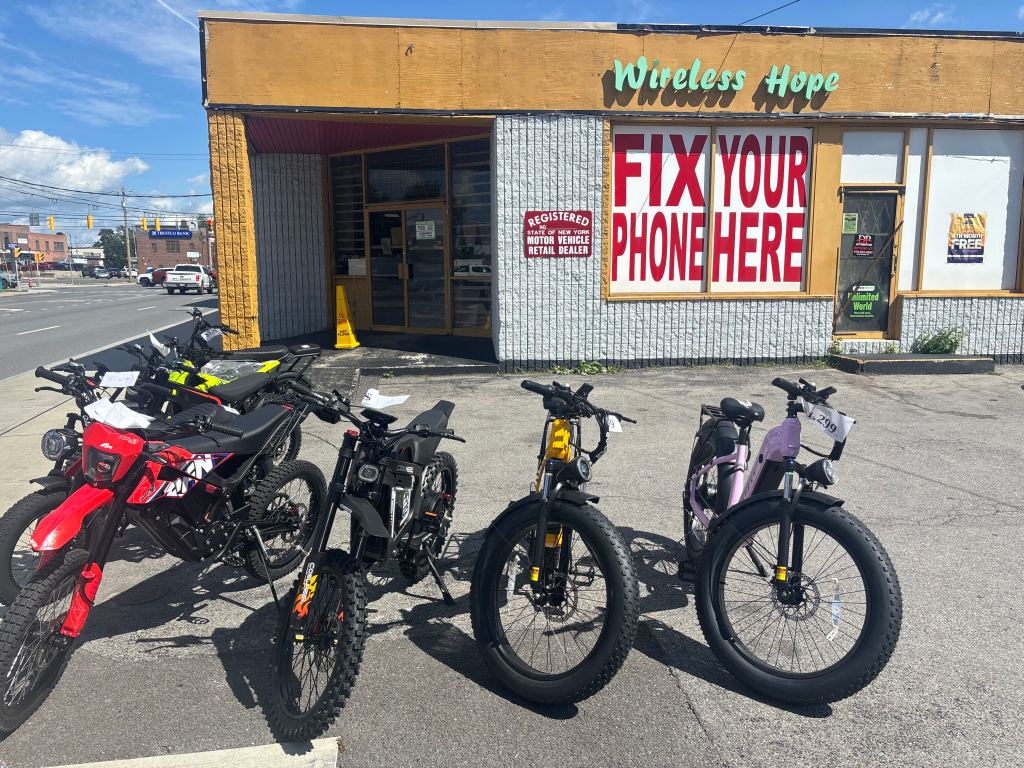
Mamdani’s administration and James’ office have both tried to attack the problem at its source — the online retailers marketing illegal e-motos as e-bikes — rather than penalizing riders. But the approach depends almost entirely on someone actually filing a complaint, and so far almost nobody has. Since James’ alert went out, her office has received exactly one complaint about a New York retailer selling illegal e-bikes or e-motos, ironically, against Wireless Hope, an electronics shop in Schenectady.
Albany doesn’t have an answer (yet)
If local officials are confused, state lawmakers aren’t dramatically ahead of them.
Ramos, who lost her bid for re-election in June, called it discriminatory back in March for police to use a law that never mentions e-bikes to confiscate them, pointing to “the scourge of the federal government on our immigrant neighbors” and a county government run by County Executive Bruce Blakeman, an immigration hardliner in the mold of the Trump administration.
In a statement, State Senate Transportation Committee Chair Jeremy Cooney (D-Rochester) would only say he would be “examining whether we need to strengthen regulations” when the state Legislature reconvenes in 2027.
Lawmakers ultimately declined to take up e-bike regulations at all this year, even as more than a dozen municipalities move ahead with their own, and state Department of Motor Vehicles officials acknowledged at the January hearing they don’t even have basic data on how many e-bikes are on New York roads, since the state doesn’t require registration.
Part of the problem, Ramos suggested in March, is structural. The 2020 law was negotiated inside a state budget, where, as she put it, lawmakers get “a whole lot of hurry up and wait” and take what they can get at 3 a.m. before a vote.
“If it was a more traditional legislative process,” she said at the time, “it is probable that we would have had a much more robust discussion and, therefore, a much more comprehensive law.”
That could change in 2027. State Sen. Kristen Gonzalez (D-Long Island City) introduced legislation last week to explicitly ban the sale of e-motos in New York and allow fines up to $1,000 for vendors who continue to sell the devices. The bill was developed in consultation with James’s office and extends a sales ban to “electric off-highway motorcycles,” which often include dirt bike iconography and design features and are solely intended for use off-road or on private property. Yet those same devices are often spotted on public roadways, where they are illegal, and marketed to e-bike consumers.
Gonzalez, whose district was home to a fatal crash on the Queensboro Bridge involving an illegal stand-up scooter in May, told Streetsblog that the need to protect residents and workers who rely on e-bikes, while also shielding them from illegal devices, isn’t limited to the five boroughs.
“As a statewide legislature, we have to be responsive to new technologies,” she said.
A moral panic, not a crime wave
Hunter College sociologist Mike Owen Benediktsson has a name for what’s happening in town halls from Nassau to the North Country: a moral panic.
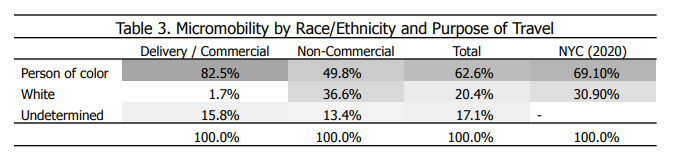
Benediktsson and a team of researchers spent three weeks in late 2025 systematically observing 1,736 micromobility vehicles at 155 intersections across New York City to test the premise directly, publishing the results in a January report, “Micromobility in NYC: 2025.”
The findings cut hard against the narrative driving so much of the backlash. Delivery workers — the group often blamed in public discourse for reckless riding — turned out to be dramatically more law-abiding than recreational riders.
In the study, 55 percent of delivery workers stopped fully at red lights and waited for green, versus 29 percent of non-commercial riders; only 18 percent of delivery workers blew through red lights at speed, compared with 29 percent of everyone else. When pedestrians were crossing, delivery workers yielded 79 percent of the time; non-commercial riders yielded just 56 percent of the time.
“There’s every reason to think that they would be safer,” Benediktsson said, pointing to how much more time delivery riders spend on their bikes and how much they have to lose, like their livelihood, their equipment, a ticket, if they crash or get stopped.
“There’s been this kind of discrepancy between the data that we found and the focus of public debate,” he said, calling the mismatch a “dog whistle aspect” he can’t fully explain away.
He also wasn’t shy about naming what drives the disconnect between data and outrage: a small number of genuinely tragic, isolated crashes combined with a vocal, locally influential slice of residents reacting to a large-scale change in streetscapes people had naturalized. Age plays a similar role in places without much of a delivery culture, where the loudest complaints are about teenagers doing wheelies rather than deliveristas.
“It’s not driven by rationality,” Benediktsson said. “It’s driven by kind of like a sort of fear and exaggerated focus on the worst-case scenarios and the most extreme cases.”
None of that, he added, means the risk to kids or others on deregulated, throttle-heavy e-motos is imaginary, just that the appropriate response is “precise” and “data-driven,” rather than a “knee-jerk emotional response.”
To be fair, not every official conflates the categories.
Broome County Sheriff Fred Akshar, launching the Town of Union enforcement sweep this summer, was careful to draw a line.
“We’re not after riders lawfully navigating our community’s streets and roads,” he told a local news outlet in July. “Our concern is on juveniles treating dirt bikes like cars, joyriding through the streets.”
Engineering, education and enforcement
Perhaps the most consistent thread running through the state’s e-bike backlash is what’s missing: bike lanes.
The Hunter study’s data made the case mathematically. Where protected bike lanes exist, 85 percent of micromobility riders use them and less than 3 percent end up on the sidewalk. Where there’s no bike lane at all, sidewalk riding jumps to nearly 13 percent — evidence, the researchers wrote, “that riders move onto sidewalks when they do not feel adequately protected in the roadway.”
Painted, unprotected lanes performed worse on some measures than having no lane at all, since riders and drivers drift in and out of them unpredictably.
Geneva City Council Member James Petropoulos, who pushed his city’s new law after fielding months of complaints, framed the problem almost entirely as enforcement and education, and as a result his fix leans on a mandatory safety course and a registration sticker.
The trouble, as he told Streetsblog, is that “the technology’s outpaced the law,” and until now, police could stop underage riders but had no ability to penalize them.
“We’re not looking to ban e-bikes,” he said. “However, we are looking for the ability to confiscate them.”
In the Village of Pittsford, outside Rochester, officials have actually acknowledged that infrastructure gap.
“Our mayor has been struck twice by bicycles … I know I’ve been hit once before,” Pittsford Village Trustee David Wilkes said in February while backing a proposal to bar bikes and e-bikes from village sidewalks, according to contemporaneous news reports.
But Wilkes didn’t stop at restriction.
“If [the state Department of Transportation] is listening, we would love to have bike lanes,” he said. “We have, two, actually three state highways crisscrossing our village. And we would love to have additional funding to help us to build those proper bike lanes.”

Read More:
Streetsblog has migrated to a new comment system. New commenters can register directly in the comments section of any article. Returning commenters: your previous comments and display name have been preserved, but you'll need to reclaim your account by clicking "Forgot your password?" on the sign-in form, entering your email, and following the verification link to set a new password — this is required because passwords could not be carried over during the migration. For questions, contact tips@streetsblog.org.