POL PLOT: Hochul’s Insurance Plan Is A Statewide Head-Scratcher
ALBANY — Lawmakers from every corner of New York State are simply unexcited about Gov. Hochul’s proposal to reform car insurance.
The governor continues to ask legislators to believe that her plan to lower auto insurance rates isn’t simply trading away the legal rights of crash victims on behalf of saving $25 a month for motorists — and lawmakers’ response continues to be more questions about whether the savings she promises will even materialize.
The governor blames that lack of faith on attorneys she mocks as “billboard lawyers,” also known as the New York State Trial Lawyers Association. She’s also resorted to threatening politicians with electoral consequences if they don’t get on her bandwagon.
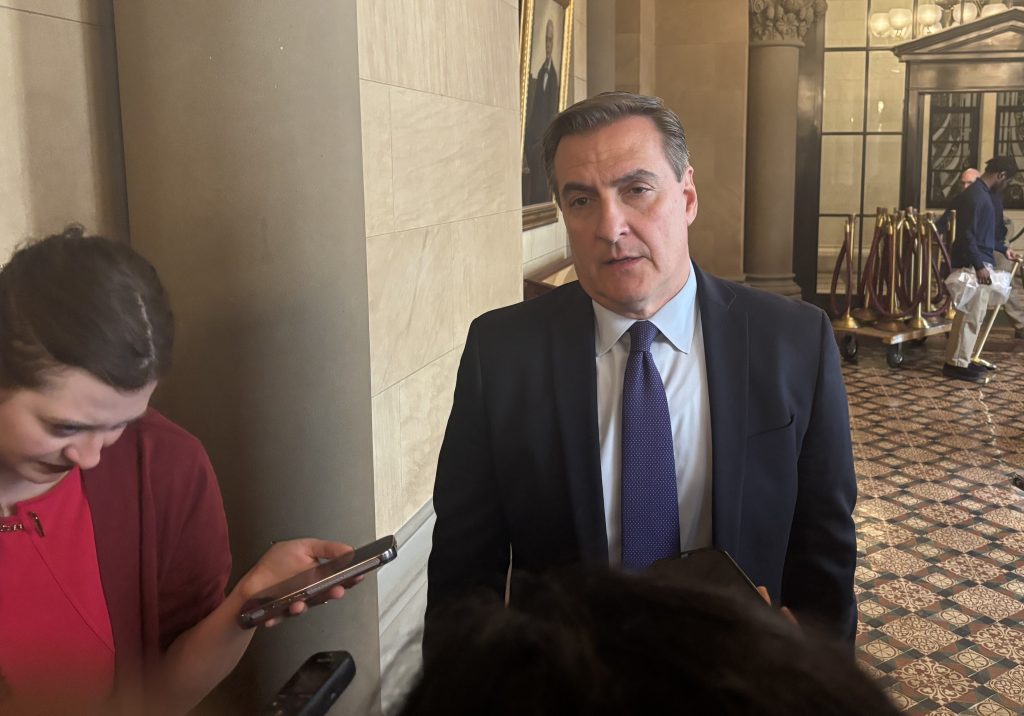
“We want to do something that makes sense and that benefits people,” said state Senate Deputy Majority Leader Mike Gianaris, summarizing the prevailing vibe in the Capitol. “If you can go home and say, ‘I did this, and it’s going to lower your insurance rates,’ people will be very happy. [But] I don’t see in the proposals that have happened that that’s where we are.”
The governor argues that prices will go down if the state chips away at the rights of crash victims to sue for damages. That includes narrowing the state’s definition of “serious injury,” which entitles victims to seek damages after no-fault insurance’s $50,000 in coverage is exhausted.
No-fault insurance essentially becomes the victim’s health insurance, covering their medical expenses. It can also cover up to $2,000 a month in lost wages, and up to $25 per day for essential transportation. Since those costs can quickly exceed $50,000, victims who have serious injuries often sue the driver to get more compensation.
Currently, the term “serious injury” includes injuries like fractures, permanent loss of an organ or member, loss of a fetus, or a medically determined non-permanent injury that keeps one out of work for more than 90 days.
Hochul wants to disqualify people in that last category, even if the injuries keep victims from going through their day-to-day lives for three months. This would have a dramatic effect on crash victims with traumatic brain injuries or soft tissue injuries because they don’t neatly fit the remaining definitions.
Currently, in trials, juries apportion blame for a crash in percentages, and each party receives compensation for pain and suffering that corresponds to their share of responsibility. The governor also wants to change that system so that drivers who are found at least 51 percent responsible for a crash would get no compensation beyond no-fault, even if a jury finds that the other driver or victim, such as a cyclist who jumped a red light, shares a significant portion of blame.
Hochul also proposed limiting pain and suffering damages for drivers who are uninsured at the time of a crash. This applies not only to people who intentionally drive without insurance, but also anyone borrowing a car from someone else and without coverage in place.
Lawmakers are so untrusting that they’re doing their own research. Assembly Member Michaelle Solages (D-Nassau County) said insurance companies have given her no reason to believe the governor’s proposal will lower rates.
“One insurance company I’m not going to name, said that, ‘Oh, well, we already have the lowest amount of rates and premiums, so we’re not gonna be able to pass off any savings,’ whereas others are just being coy about it,” Solages, chair of the state Legislature’s Black, Puerto Rican, Hispanic & Asian Legislative Caucus, told Streetsblog.
And Streetsblog, as well as Solages, has heard from State Farm, a rare insurer with a corporate structure owned by policyholders rather than shareholders, that they can’t promise reduced rates. The company has offered rebates to New York consumers of its own volition, but said there are several cost drivers at play when setting rates, so, though the governor’s proposal is welcomed, it isn’t a cure-all.
She added that the governor’s comparison to Florida’s 2022 and 2023 reforms also doesn’t track because “that dynamic doesn’t really exist here in New York.” Florida insurers have to factor in regular hurricanes, for example, into their calculations.
In Solages’s opinion, the governor could solve the alleged fraud problem simply with better regulation. And even if the governor’s proposal worked out perfectly, it would take years for savings to be realized by consumers.
Hochul has relied on the argument that New York’s “Excess Profit Law” will force insurance companies to return the savings from her proposal to customers. (The Hochul administration approved a 22-percent increase in car insurance rates in 2024.)
However, under the Excess Profit Law, insurers with an average rate of return on net worth (a profitability metric) of more than 21 percent over six years can be forced to return a share of profits to policyholders. There is no evidence that this has ever happened.
And according to the state Department of Financial Services, insurance companies that are seeing record profits have not been making a profit in New York recently, so this has been unenforceable.
“If we’re talking about money going back to the car owner, it’s going to be in two years, three years,” Solages said. “This is not like a light switch.”
Like Solages, state Senate Investigations Chair James Skoufis (D-Orange County) represents a car-dependent constituency. He said that car insurance is easily a top-five cost for households in his district.
At the same time, parts of the governor’s proposal on insurance don’t sit well with him. Affordability doesn’t mean much if you can’t pay your hospital bills.
“I have some discomfort with the comparative responsibility proposal whereby, if you are even just 51 percent responsible for an auto accident [sic], you cannot collect any sort of reward in those incidents. … I think there are instances like that where we have to be more sensitive,” Skoufis said. “But anything that we out of hand push back on or we, as a Senate or Assembly … I believe it’s important to advance some substitute proposal in its place.”
Some of his colleagues have done just that. Assembly Member Jen Lunsford (D-Monroe County) and state Sen. April Baskins (D-Buffalo) introduced legislation (A10524A/S9537A) that would limit the data that insurers use when they set premiums and make the overall rate-setting process more transparent for the public. A similar bill (A10616/SS1655) from state Senate Insurance Chair Jamaal Bailey (D-Bronx) and Assembly Member Jeffrey Dinowitz (D-Bronx) would force insurance companies to be clearer about how they set rates and why.
And lawmakers representing less car-dependent constituencies also are working toward a version of the proposal that won’t leave crash victims in the lurch.
“The governor … wants to make it more difficult for people to get awards from accidents, because New York has one of the highest payouts for accidents in the country,” said state Sen. Erik Bottcher (D-Manhattan). “We want to make sure that we come up with something that doesn’t hurt actual victims of accidents.”
Lawmakers also wonder why they, or the New Yorkers they represent, should have any faith in insurers playing ball when it comes to lowering rates. They’ve made record profits in recent years, but a downturn, specifically in New York, is part of the justification for Hochul’s proposal. Lawmakers like Skoufis say the focus should be on the profits of these large companies: “We absolutely need to also be looking at it.”
State Sen. Julia Salazar (D-Brooklyn) recognizes that New Yorkers need a more affordable life; she and her colleagues in the New York City chapter of the Democratic Socialists of America have been pushing for taxes on corporations and the rich for that very reason. But the governor’s proposal, as written, leaves too many questions for victims.
“I am concerned about a negative impact on plaintiffs who suffer serious injury and have the need for their medical care or expenses to be covered, and a proposal that fails to actually give them justice, or allow for them to be awarded justice financially,” Salazar said, “Apart from that, I do think that there needs to be reform.”
Ultimately, some version of the governor’s proposal will likely end up in the final state budget, if nothing else, because the state’s executive weilds so much power in the process. The real question at this point is what concessions she needs to make for everyone to get
“There’s been a little too much demonizing of our attorneys who seek justice every day for people who are injured through negligence,” said state Sen. Jeremy Zellner (D-Erie County), who also doubles as Erie County Democratic Party chair. “And I think if you are injured through negligence, you should be able to seek justice at all costs. So there’s going to be some give and take.”
This article has been updated to further clarify the role of no-fault insurance and the discussions lawmakers have had with insurance companies.

Read More:
Streetsblog has migrated to a new comment system. New commenters can register directly in the comments section of any article. Returning commenters: your previous comments and display name have been preserved, but you'll need to reclaim your account by clicking "Forgot your password?" on the sign-in form, entering your email, and following the verification link to set a new password — this is required because passwords could not be carried over during the migration. For questions, contact tips@streetsblog.org.