State Senate Majority Leader Wants Answers on Insurance
ALBANY — An explanation would be nice.
At least that’s how state Senate Majority Leader Andrea Stewart-Cousins feels about Gov. Hochul’s controversial scheme to cut auto insurance premiums as legislative leaders head into budget negotiations.
The governor is pushing an Uber-backed proposal that seeks to reduce car insurance costs by reducing the amount of compensation that crash victims can receive — but skepticism is growing, even in the pro-car legislature, that Hochul’s plan will actually lower rates.
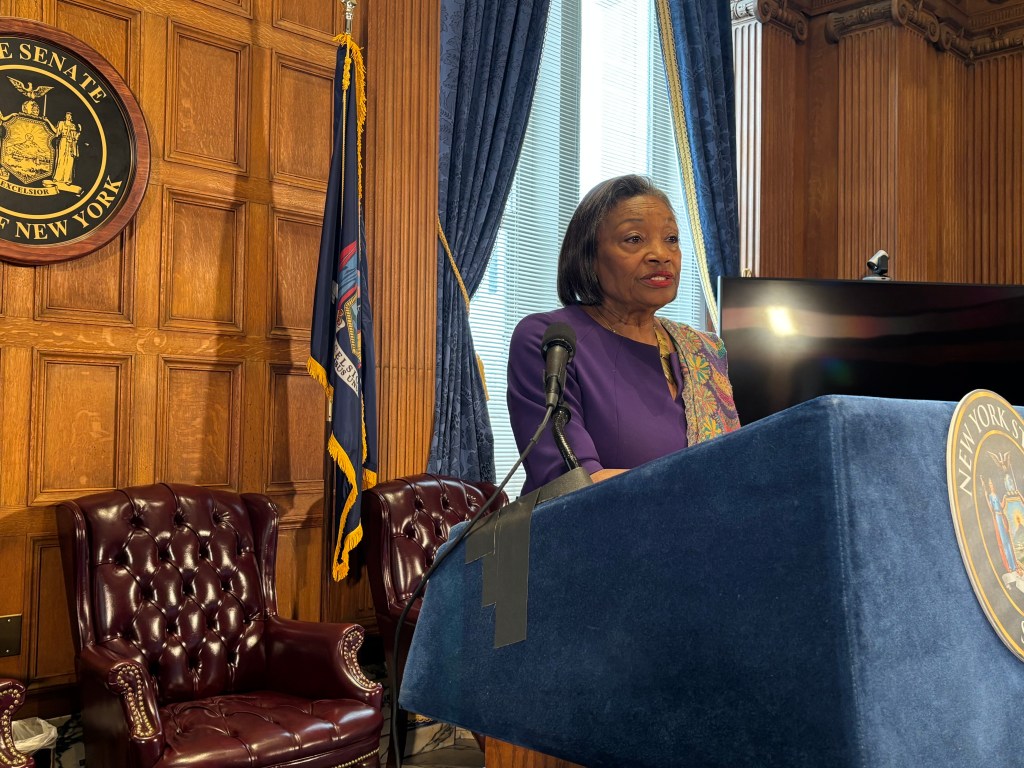
“She’s put forward her proposal and we are as interested [as] anyone in making sure that we are not overcharged and subjected to fraud,” Stewart-Cousins told reporters on Wednesday. “So I believe we’ll have a broader conversation.”
Streetsblog asked if Stewart-Cousins wanted the governor to explain what promise there is insurance companies would actually lower their rates.
“Yes, sir,” she said.
The governor has proposed narrowing the state’s definition of “serious injury,” the legal threshold that allows crash victims to sue for pain and suffering beyond the state’s no-fault insurance coverage, which is $50,000.
Currently, that includes injuries like fractures, permanent loss of an organ or member, loss of a fetus, or a medically determined non-permanent injury that keeps one out of work for more than 90 days.
Hochul wants to disqualify people in that latter category of non-permanent injuries, even if the injuries keep victims from going through their day-to-day for three months. This would have a dramatic effect on crash victims with traumatic brain injuries or soft tissue injuries because they don’t neatly fit the remaining definitions.
In trials, juries apportion blame for a crash in percentages, and the award that each party receives for pain and suffering corresponds to their share of responsibility. The governor also wants to change that system so that parties who are found 51 percent or more responsible for a crash would not be able to recover damages from the other party, even if the other driver also shares some blame.
The governor’s plan pairs these changes in coverage with legislation that would make it easier for district attorneys in New York to target individual actors and organized rings committing car insurance fraud, like staged crashes.
Many state lawmakers are eager to be seen as champions of affordability and opponents of fraud in an election year, but Hochul’s proposal has raised issues of fairness for victims while not explicitly saying how it would consistently lower auto premiums.
And there are other ways for skeptical lawmakers to express concern for New Yorkers’ wallets, with utilities becoming a recent sticking point.
The Hochul administration argues that after the auto insurance proposal starts saving insurance companies money, the state Department of Financial Services could force companies to pass along those to customers under the “Excess Profit Law.”
“Gov. Hochul is proposing common-sense reforms that will make our streets safer and bring needed relief to New York who pay among the highest insurance rates in the nation,” Hochul spokesperson Sean Butler said in a statement. “Thanks to New York’s nation-leading consumer protection laws, the savings realized by these reforms must be passed on to policyholders, and the governor has directed DFS to ensure that drivers see as much relief as possible if these reforms pass.”
Under the Excess Profit Law, insurers with an average rate of return on net worth of more than 21 percent over six years can be forced to return a share of profits to policyholders. There is no evidence that this has ever happened.
But some companies do issue refunds of their own volition. State Farm told Streetsblog that it was issuing dividends averaging $81 per vehicle to 2025 policyholders in New York, totalling $127 million, joining similar payments made in other states. However, the DFS’s Acting Superintendent Kaitlin Asrow told lawmakers at a recent budget hearing that insurance companies haven’t been profitable in New York for five years.
The state Senate, which is more comfortable with including policy without a fiscal impact in its budget rebuttal than the Assembly, is expected to stake out its position on insurance next week in its one-house budget.
“These are the basis for the three-way conversations that will no doubt ensue based on that particular proposal, and we’re looking forward to having more robust conversation about it,” Stewart-Cousins said.
It’s not the first time lawmakers have expressed confusion or trepidation about Gov. Hochul’s plan.
Assembly Insurance Chair David Weprin (D-Queens) said he isn’t 100 percent behind the proposal, though he backs any attempt to reduce auto insurance fraud.
And state Senate Insurance Chair Jamaal Bailey (D-Bronx) took Asrow and insurance industry representatives to task at a recent budget hearing, asking how insurance companies would set pricing following legislative action on Hochul’s proposal. Like Stewart-Cousins, he also wanted the Hochul administration to explain how the proposal doesn’t end up shortchanging crash victims.
At the same hearing, state Senate Finance Chair Liz Krueger (D-Manhattan) also had trouble fathoming an auto insurance system that didn’t gouge customers.
“We also don’t want people’s civil rights to be taken away from them through the court system when something bad happens,” she said.
Among Krueger, Stewart-Cousins, Bailey and Weprin, there are two law degrees and two Masters degrees. If highly educated and deeply experienced state lawmakers, laser-focused on making New Yorkers’ lives more affordable, have real questions about Hochul’s proposal, the governor may be in for a defeat.
This article has been updated to clarify the governor’s auto insurance proposal.

Read More:
Streetsblog has migrated to a new comment system. New commenters can register directly in the comments section of any article. Returning commenters: your previous comments and display name have been preserved, but you'll need to reclaim your account by clicking "Forgot your password?" on the sign-in form, entering your email, and following the verification link to set a new password — this is required because passwords could not be carried over during the migration. For questions, contact tips@streetsblog.org.